Astronomy and Space
IRAS
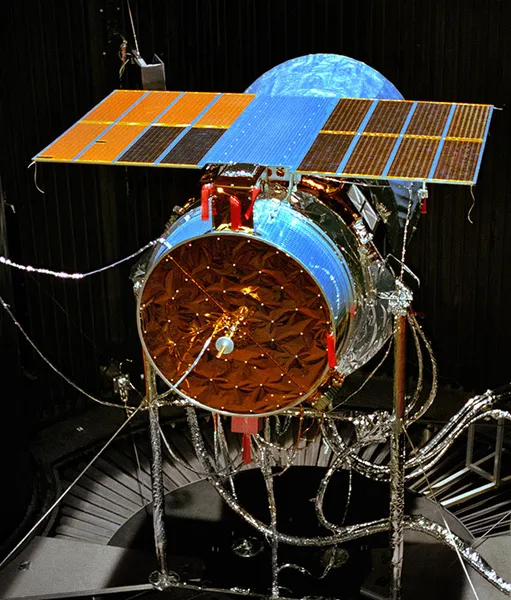
The Infrared Astronomical Satellite (Dutch: Infrarood Astronomische Satelliet) (IRAS) was the first space telescope to perform a survey of the entire night sky at infrared wavelengths. Launched on 25 January 1983, its mission lasted ten months. The telescope was a joint project of the United States (NASA), the Netherlands (NIVR), and the United Kingdom (SERC). Over 250,000 infrared sources were observed at 12, 25, 60, and 100 micrometer wavelengths. Support for the processing and analysis of data from IRAS was contributed from the Infrared Processing and Analysis Center at the California Institute of Technology. Currently, the Infrared Science Archive at IPAC holds the IRAS archive. The success of IRAS led to interest in the 1985 Infrared Telescope (IRT) mission on the Space Shuttle, and the planned Shuttle Infrared Telescope Facility which eventually transformed into the Space Infrared Telescope Facility, SIRTF, which in turn was developed into the Spitzer Space Telescope, launched in 2003. The success of early infrared space astronomy led to further missions, such as the Infrared Space Observatory (1990s) and the Hubble Space Telescope's NICMOS instrument.
Also on this shelf
Frederick L. Scarf.
5 Tauri.
See also
Uncatalogued shelfText from Wikipedia; plate via Wikimedia Commons. Text CC BY-SA 4.0; plate freely licensed (see Commons). Source record. Images and catalogue data are reproduced from open-access collections.