Astronomy and Space
Human mission to Mars
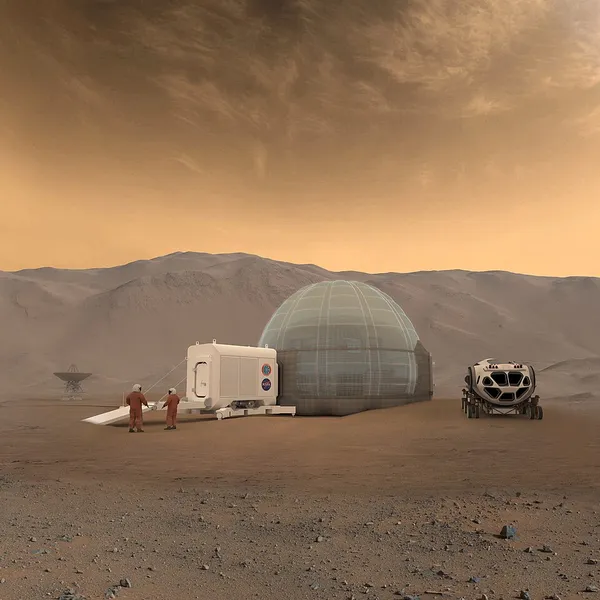
The idea of sending humans to Mars has been the subject of aerospace engineering and scientific studies since the late 1940s as part of the broader exploration of Mars. Long-term proposals have included sending settlers and terraforming the planet. Currently, only robotic landers, rovers and a helicopter have been on Mars. As of 2026, the farthest humans have been beyond Earth is the Moon and its vicinity, with the lunar flights of the Apollo program from 1968 to 1972 and the Artemis II lunar flyby in 2026, both of which were operated by NASA. Conceptual proposals for missions that would involve human spaceflight started in the early 1950s, with planned missions typically expected to take place between 10 and 30 years after they were drafted. The list of crewed Mars mission plans shows the proposals put forth by multiple organizations and space agencies in this field of space exploration. These plans have varied – from scientific expeditions, in which a small group (between two and eight astronauts) would visit Mars for a period of a few weeks or more, to a continuous presence (e.g. through research stations, colonization, or other continuous habitation). Some have also considered exploring the Martian moons Phobos and Deimos. By 2020, virtual visits to Mars, using haptic technology, had also been proposed. Meanwhile, uncrewed exploration of Mars has been a goal of national space programs for decades, and was first achieved in 1965 with the Mariner 4 flyby. Human missions to Mars have been part of science fiction since the 1880s, and more broadly, in fiction, Mars is a frequent target of exploration and settlement in books, graphic novels, and films. The concept of a Martian as something living on Mars is part of the fiction. Proposals for human missions to Mars have come from agencies such as NASA, the European Space Agency, CNSA, Boeing, SpaceX, and space advocacy groups such as the Mars Society and The Planetary Society.
Also on this shelf
HD 179949.
Epsilon Columbae.
See also
- ▸Beta Pavonis
- ▸Bredgar and Wormshill Light Railway
- ▸History of Solar System formation and evolution hypotheses
Text from Wikipedia; plate via Wikimedia Commons. Text CC BY-SA 4.0; plate freely licensed (see Commons). Source record. Images and catalogue data are reproduced from open-access collections.