Astronomy and Space
Liquid apogee engine
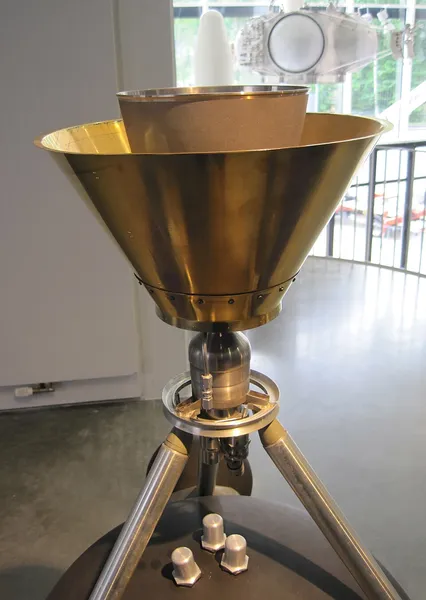
A liquid apogee engine (LAE), or apogee engine, refers to a type of chemical rocket engine typically used as the main engine in a spacecraft. The name apogee engine derives from the type of manoeuvre for which the engine is typically used, i.e. an in-space delta-v change made at the apogee of an elliptical orbit in order to circularise it. For geostationary satellites, this type of orbital manoeuvre is performed to transition from a geostationary transfer orbit and place the satellite on station in a circular geostationary orbit. Despite the name, an apogee engine can be used for a range of other manoeuvres, such as end-of-life deorbit, Earth orbit escape, planetary orbit insertion and planetary descent/ascent. In some parts of the space industry an LAE is also referred to as a liquid apogee motor (LAM), a liquid apogee thruster (LAT) and, depending on the propellant, a dual-mode liquid apogee thruster (DMLAT). Despite the ambiguity with respect to the use of engine and motor in these names, all use liquid propellant. An apogee kick motor (AKM) or apogee boost motor (ABM) such as the Waxwing, however, uses solid propellant. These solid-propellant versions are not used on new-generation satellites.
Also on this shelf
ETS-VII.
Caesium.
See also
Uncatalogued shelfText from Wikipedia; plate via Wikimedia Commons. Text CC BY-SA 4.0; plate freely licensed (see Commons). Source record. Images and catalogue data are reproduced from open-access collections.