Astronomy and Space
Betelgeuse
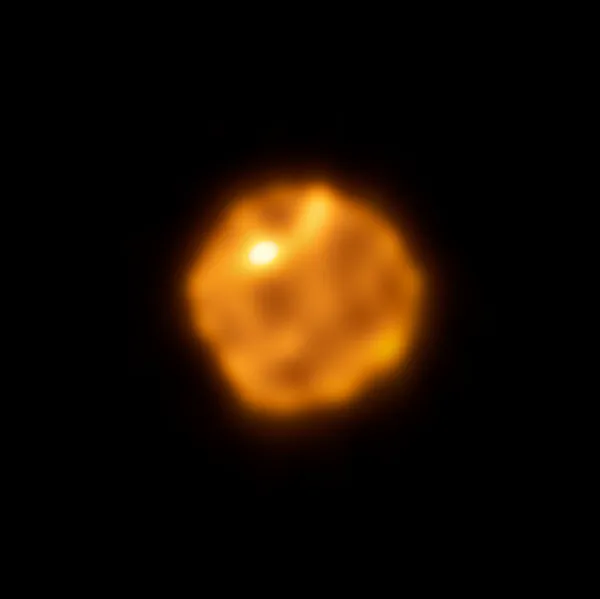
Betelgeuse is a red supergiant star in the equatorial constellation of Orion. It is usually the tenth-brightest star in the night sky and, after Rigel, the second brightest in its constellation. It is a distinctly reddish, semiregular variable star whose apparent magnitude, varying between +0.0 and +1.6, with a main period near 400 days, has the widest range displayed by any first-magnitude star. Betelgeuse is the brightest star in the night sky at near-infrared wavelengths. Its Bayer designation is α Orionis, Latinised to Alpha Orionis and abbreviated Alpha Ori or α Ori. With a radius between 640 and 764 times that of the Sun, if it were at the center of the Solar System, its surface would lie beyond the asteroid belt and it would engulf the orbits of Mercury, Venus, Earth, and Mars. Calculations of Betelgeuse's mass range from slightly under ten to a little over twenty times that of the Sun. For various reasons, its distance has been quite difficult to measure; current best estimates are of the order of 400–600 light-years from the Sun – a comparatively wide uncertainty for a relatively nearby star. Its absolute magnitude is about −6. With an age of less than 10 million years, Betelgeuse has evolved rapidly because of its large mass, and is expected to end its evolution with a supernova explosion, most likely within 100,000 years. When Betelgeuse detonates as a brilliant type II supernova, it will shine as bright as the half-Moon for more than three months; life on Earth will be unharmed. Having been ejected from its birthplace in the Orion OB1 association – which includes the stars in Orion's Belt – this runaway star has been observed to be moving through the interstellar medium at a speed of 30 km/s, creating a bow shock over four light-years wide. Betelgeuse became the first extrasolar star whose photosphere's angular size was measured in 1920, and subsequent studies have reported an angular diameter (i.e., apparent size) ranging from 0.042 to 0.056 arcseconds; that range of determinations is ascribed to non-sphericity, limb darkening, pulsations and varying appearance at different wavelengths. It is also surrounded by a complex, asymmetric envelope, roughly 250 times the size of the star, caused by mass loss from the star itself.
Also on this shelf
Eugene Parker.
1965.
See also
Uncatalogued shelfText from Wikipedia; plate via Wikimedia Commons. Text CC BY-SA 4.0; plate freely licensed (see Commons). Source record. Images and catalogue data are reproduced from open-access collections.