Astronomy and Space
Hubble Space Telescope
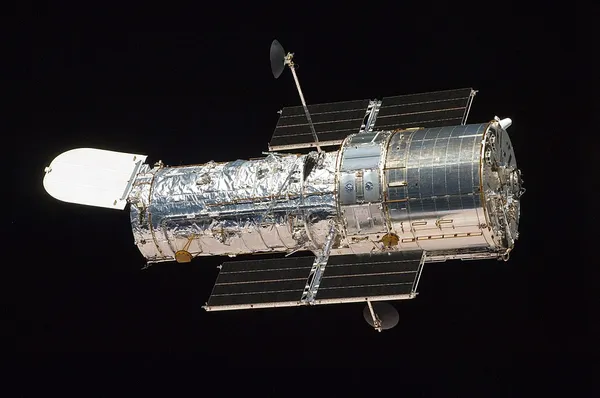
The Hubble Space Telescope (HST or Hubble) is a space telescope that was launched into low Earth orbit in 1990 and remains in operation. It was not the first space telescope, but it is one of the largest and most versatile, renowned as a vital research tool and as a public relations boon for astronomy. The Hubble Space Telescope is named after astronomer Edwin Hubble and is one of NASA's Great Observatories. The Space Telescope Science Institute (STScI) selects Hubble's targets and processes the resulting data, while the Goddard Space Flight Center (GSFC) controls the spacecraft. Hubble features a 2.4 m (7 ft 10 in) mirror, and its five main instruments observe in the ultraviolet, visible, and near-infrared regions of the electromagnetic spectrum. Hubble's orbit outside the distortion of Earth's atmosphere allows it to capture extremely high-resolution images with substantially lower background light than ground-based telescopes. It has recorded some of the most detailed visible light images, allowing a deep view into space. Many Hubble observations have led to breakthroughs in astrophysics, such as determining the rate of expansion of the universe. The Hubble Space Telescope was funded and built in the 1970s by NASA with contributions from the European Space Agency. Its intended launch was in 1983, but the project was beset by technical delays, budget problems, and the 1986 Challenger disaster. Hubble was launched on STS-31 in 1990, but its main mirror had been ground incorrectly, resulting in spherical aberration that compromised the telescope's capabilities. The optics were corrected to their intended quality by a servicing mission, STS-61, in 1993. Hubble is the only telescope designed to be maintained in space by astronauts. Five Space Shuttle missions repaired, upgraded, and replaced systems on the telescope, including all five of the main instruments. The fifth mission was initially canceled on safety grounds following the Columbia disaster (2003), but after NASA administrator Michael D. Griffin approved it, the servicing mission was completed in 2009.
Also on this shelf
47 Ophiuchi.
Cape Canaveral Space Launch Complex 40.
See also
Uncatalogued shelfText from Wikipedia; plate via Wikimedia Commons. Text CC BY-SA 4.0; plate freely licensed (see Commons). Source record. Images and catalogue data are reproduced from open-access collections.