Astronomy and Space
Apus
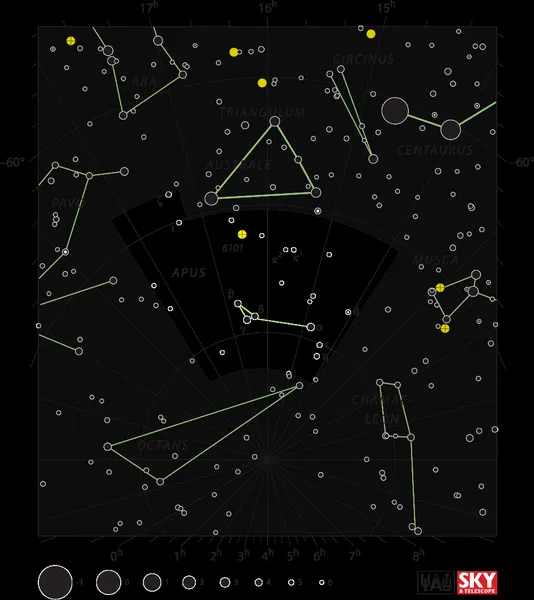
Apus is a small constellation in the southern sky. It represents a bird-of-paradise, and its name means "without feet" in Greek because the bird-of-paradise was once wrongly believed to lack feet. First depicted on a celestial globe by Petrus Plancius in 1598, it was charted on a star atlas by Johann Bayer in his 1603 Uranometria. The French explorer and astronomer Nicolas Louis de Lacaille charted and gave the brighter stars their Bayer designations in 1756. The five brightest stars are all reddish in hue. Shading the others at apparent magnitude 3.8 is Alpha Apodis (formally named Paradys), an orange giant that has around 48 times the diameter and 928 times the luminosity of the Sun. Marginally fainter is Gamma Apodis, another aging giant star. Delta Apodis is a double star, the two components of which are 103 arcseconds apart and visible with the naked eye. Two star systems have been found to have planets.
Also on this shelf
617 Patroclus.
Carcassone Montes.
See also
Uncatalogued shelfText from Wikipedia; plate via Wikimedia Commons. Text CC BY-SA 4.0; plate freely licensed (see Commons). Source record. Images and catalogue data are reproduced from open-access collections.