Astronomy and Space
Cape Canaveral Launch Complex 36
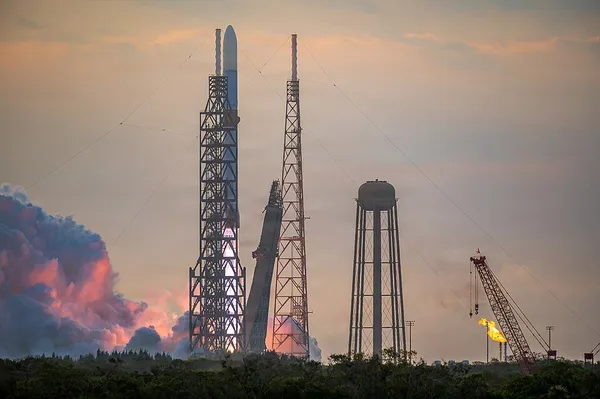
Launch Complex 36 (LC-36) is a launch complex located at the Cape Canaveral Space Force Station in Florida. Located south of the Missile Row launch range, the complex originally consisted of two pads—designated LC-36A and LC-36B—to support the flights of Atlas launch vehicles equipped with a Centaur upper stage. From the 1960s to the 1980s, LC-36 was used by NASA and the United States Air Force to launch many payloads from the Atlas-Centaur and its derivatives, including the Pioneer, Surveyor, and Mariner probes. During the late 1980s, LC-36B was also used to launch the Atlas G, and General Dynamics (and later Lockheed Martin) modified the two pads to support the larger Atlas I, Atlas II, and Atlas III throughout the 1990s and early 2000s. Following the Atlas program's relocation to Space Launch Complex 41 (SLC-41) in 2005, LC-36 stood vacant until Blue Origin acquired the lease in 2015 for use by their heavy-lift New Glenn rocket. The company made extensive modifications to the complex during this time, including demolishing 36A and 36B, rebuilding one large 36A in their place, as well as integrating the neighboring Launch Complex 11 (LC-11) into the facility. Following this large-scale renovation, the new era of LC-36 commenced with the maiden flight of New Glenn in January 2025. On May 28, 2026, a catastrophic failure during a static fire attempt of New Glenn resulted in significant damage to the pad. Blue Origin plans to build a new LC-36B, even larger than the rebuilt LC-36A, capable of supporting the larger 9×4 variant of New Glenn.
Also on this shelf
Carina (constellation).
ATE Vulture.
See also
Uncatalogued shelfText from Wikipedia; plate via Wikimedia Commons. Text CC BY-SA 4.0; plate freely licensed (see Commons). Source record. Images and catalogue data are reproduced from open-access collections.