Astronomy and Space
Kepler-1649c
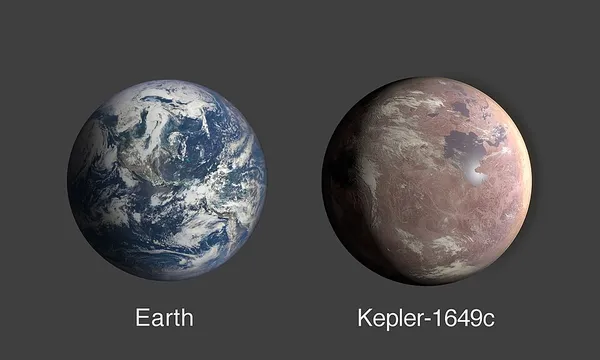
Kepler-1649c is an Earth-sized exoplanet, likely rocky, orbiting within the habitable zone of the red dwarf star Kepler-1649, the outermost planet of the planetary system discovered by Kepler’s space telescope. It is located about 301 light-years (92 pc) away from Earth, in the constellation of Cygnus. Kepler-1649c orbits its star a distance of 0.0649 AU (9.71 million km; 6.03 million mi) from its host star with an orbital period of roughly 19.53 days, has a mass 1.2x times that of Earth, and has a radius of around 1.02 times that of Earth. Based on its mass and radius, it is likely a terrestrial planet, though its proximity to its star means it may likely be tidally locked. Kepler-1649c is estimated to receive about three-quarters of radiation from its host star as Earth does from the Sun. In 2017, Jeff Coughlin, the director of SETI's K2 Science Office, described it as the most "similar planet to Earth" found so far by the Kepler Space Telescope. The planet was initially deemed a false positive by Kepler's robovetter algorithm. The Kepler False Positive Working Group published its recovery on April 15, 2020. Its first scientific description was published in The Astrophysical Journal Letters, with first author Andrew Vanderburg, in April 2020.
Also on this shelf
Alpha Ceti.
Delta Velorum.
See also
Uncatalogued shelfText from Wikipedia; plate via Wikimedia Commons. Text CC BY-SA 4.0; plate freely licensed (see Commons). Source record. Images and catalogue data are reproduced from open-access collections.