Astronomy and Space
32 Cygni
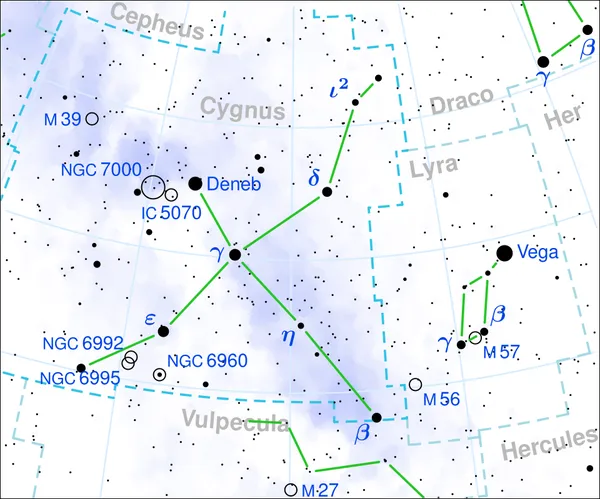
32 Cygni is a binary star system in the constellation of Cygnus. It has the Bayer designation Omicron2 Cyg, which is Latinized from ο2 Cyg and abbreviated ο3 Cyg. This is a 4th magnitude star, which can be seen with the naked eye under suitably dark skies. Parallax measurements give an estimated distance of 1,000 light-years (307 parsecs) from the Earth. However, Schröder et al. (2007) suggest the actual value, after correcting for Malmquist bias, may be closer to 1,174 light-years (360 parsecs). Although it is a spectrsocopic binary with components that cannot be separated visually, it has two entries in the Henry Draper Catalogue, with identical magnitudes and positions, but showing the spectral types of the two components. The Bayer letter ο (omicron) has been variously applied to two or three of the stars 30, 31, and 32 Cygni. 32 Cygni has been designated as either ο2 or ο3 Cygni. For clarity, it is preferred to use the Flamsteed designation 32 Cygni rather than one of the Bayer designations. The primary component in this system, 32 Cygni A, has a stellar classification of K5 Iab, indicating that it is a supergiant star. Its effective temperature of 3,840 K lies in the range for K-type stars, giving it an orange hue. This star has over seven times more than the mass of the Sun and the outer envelope has expanded to about 184 times the Sun's radius. It is radiating 6,600 times the luminosity of the Sun. 32 Cygni B, the companion star, is three times as luminous as the Sun and four times as massive. It has a much higher effective temperature of 16,200 K and is radiating over 300 times the Sun's luminosity. This star has the blue-white hue of a B7 star main sequence star. The two stars form an eclipsing binary system (variable star designation: V1488 Cyg) similar to Algol. The orbital plane of the two stars is nearly aligned with the line of sight from the Earth, so that the supergiant star eclipses the secondary component once per orbit. During an eclipse, emission lines can be seen in the spectrum of this system. These originate in the stellar wind escaping from the supergiant star. In a volume around the B star, this wind becomes ionized, resulting in a circumstellar H II region.
Also on this shelf
High Altitude Venus Operational Concept.
Alpha Lupi.
See also
Uncatalogued shelfText from Wikipedia; plate via Wikimedia Commons. Text CC BY-SA 4.0; plate freely licensed (see Commons). Source record. Images and catalogue data are reproduced from open-access collections.