Astronomy and Space
40 Eridani
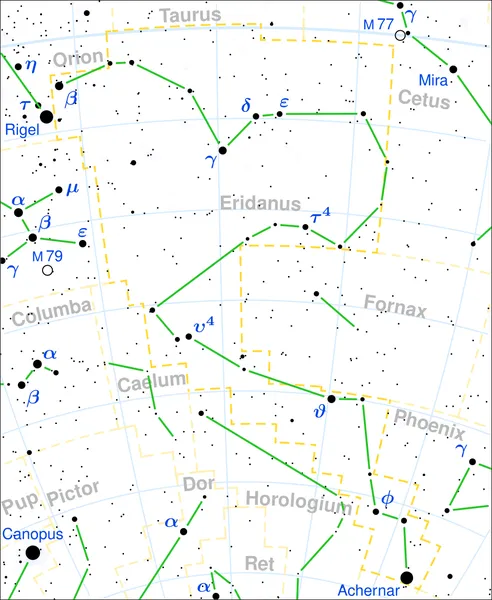
40 Eridani is a triple star system in the constellation of Eridanus, abbreviated 40 Eri. It has the Bayer designation Omicron2 Eridani, which is Latinized from ο2 Eridani and abbreviated Omicron2 Eri or ο2 Eri. Based on parallax measurements taken by the Gaia mission, it is about 16.3 light-years (5.0 parsecs) from the Sun. The primary star of the system, designated 40 Eridani A and formally named Keid, is easily visible to the naked eye, with an apparent magnitude of 4.43. It is orbited by a binary pair whose two components are designated 40 Eridani B and C, and which were discovered on January 31, 1783, by William Herschel. It was again observed by Friedrich Struve in 1825 and by Otto Struve in 1851. In 1910, it was discovered that although 40 Eridani B was a faint star, it was white in color. This meant that it had to be a small star; in fact it was a white dwarf, the first discovered. Although it is neither the closest white dwarf, nor the brightest in the night sky, it is by far the easiest to observe; it is nearly three magnitudes brighter than Van Maanen's Star, the nearest solitary white dwarf, and unlike the companions of Procyon and Sirius it is not outshone by the glare of a much brighter primary.
Also on this shelf
Human presence in space.
Double Asteroid Redirection Test.
See also
Uncatalogued shelfText from Wikipedia; plate via Wikimedia Commons. Text CC BY-SA 4.0; plate freely licensed (see Commons). Source record. Images and catalogue data are reproduced from open-access collections.