Astronomy and Space
Kepler space telescope
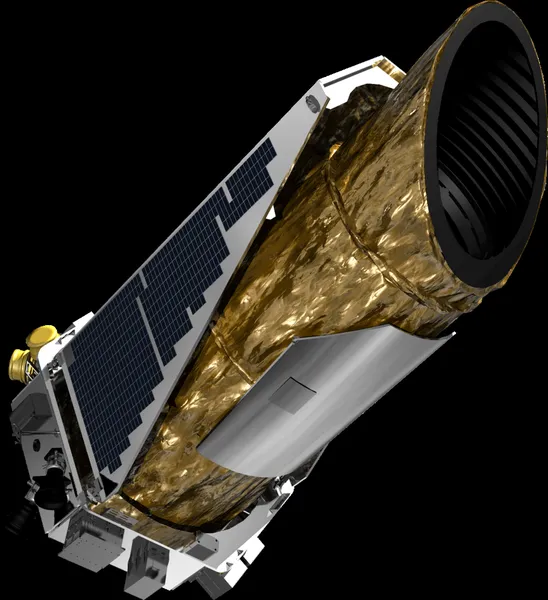
The Kepler space telescope was a space telescope launched by NASA in 2009 to discover Earth-sized planets orbiting other stars. Named after astronomer Johannes Kepler (who, ironically, was convinced that planetary systems did not exist around any of the stars) the spacecraft was launched into an Earth-trailing heliocentric orbit. The principal investigator was William J. Borucki. After nine and a half years of operation, the telescope's reaction control system fuel was depleted, and NASA announced its retirement on October 30, 2018. Designed to survey a portion of Earth's region of the Milky Way to discover Earth-size exoplanets in or near habitable zones and to estimate how many of the billions of stars in the Milky Way have such planets, Kepler's sole scientific instrument is a photometer that continually monitored the brightness of approximately 150,000 main sequence stars in a fixed field of view. These data were transmitted to Earth, then analyzed to detect periodic dimming caused by exoplanets that cross in front of their host star. Only planets whose orbits are seen edge-on from Earth could be detected. Kepler observed 530,506 stars, and had detected 2,778 confirmed planets as of June 16, 2023.
Also on this shelf
José Francisco Salgado.
Exploration of Pluto.
See also
Uncatalogued shelfText from Wikipedia; plate via Wikimedia Commons. Text CC BY-SA 4.0; plate freely licensed (see Commons). Source record. Images and catalogue data are reproduced from open-access collections.