Astronomy and Space
1951 in spaceflight
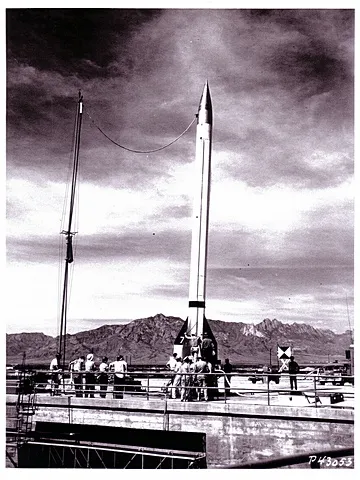
The year 1951 saw extensive exploration of space by the United States and the Soviet Union (USSR) using suborbital rockets. The Soviets launched their first series of biomedical tests to the 100-kilometre (62 mi) boundary of space (as defined by the World Air Sports Federation). Several American agencies launched more than a dozen scientific sounding rocket flights between them. The US Navy launched its Viking sounding rocket for the seventh time since 1949, this time to a record-breaking 136 miles (219 km) in August 1951. Development also continued by both superpowers on rockets more powerful than the World War Two era German V-2 that had inaugurated the age of spaceflight. The USSR advanced far beyond their R-1 (a V-2 copy) with the deployment of the R-2 rocket, which could carry a ton of explosives twice as far as its predecessor. Though the ambitious R-3 Intermediate Range Ballistic Missile was canceled in 1951, the more achievable R-5 missile project was initiated. Both the US Air Force and the US Army initiated their first post-V-2 ballistic missile projects, Atlas for the former and Redstone for the latter.
Also on this shelf
Epsilon Scuti.
(175706) 1996 FG3.
See also
Uncatalogued shelfText from Wikipedia; plate via Wikimedia Commons. Text CC BY-SA 4.0; plate freely licensed (see Commons). Source record. Images and catalogue data are reproduced from open-access collections.