Astronomy and Space
Chronology of the universe
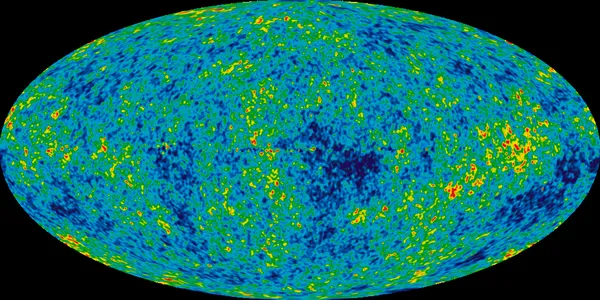
The chronology of the universe describes the history and future of the universe according to the current understanding of physical cosmology. In this model, the earliest stage that is supported by observational evidence is known as inflation, which occurred 13.8 billion years ago. During this epoch, space underwent a period of extremely rapid expansion in a tiny fraction of a second. Once inflation ended, the energy that was responsible for it was converted into particles and radiation, heating up the universe into a very hot and dense state, initiating the Big Bang. At some early stage, baryogenesis produced a small excess of matter over antimatter. Most matter and antimatter particles annihilated each other in pairs, leaving behind a small excess of matter and a large amount of radiation. As the universe cooled further, many other heavy particles annihilated each other or decayed, eventually leaving behind a plasma that was dominated by protons, neutrons, electrons, photons, and neutrinos. After the first second, the plasma became dilute enough so that neutrinos ceased interacting efficiently with the other particles and instead started free streaming through the universe, producing the primordial neutrino background. Five seconds later, pair production created electrons and positrons annihilated each other, transferring their energy into the rest of the plasma. Within the first three minutes, the temperature became low enough to enable stable nuclei to start forming in a process known as Big Bang nucleosynthesis, resulting in hydrogen, helium, and a small amount of lithium. In most models of cosmology, dark matter is usually assumed to have been produced by this epoch, although its production mechanism is unknown. Around 380,000 years later, electrons were captured by the nucleons, forming stable atoms. With this, the universe became transparent to photons, producing the cosmic microwave background. The next phase of the universe involved the gradual gravitational collapse of the atomic gas. As the gas was compressed and heated, it eventually ignited nuclear fusion, creating the first stars. Gravitational attraction over the subsequent millions of years formed galaxies and the larger structures visible today.
Also on this shelf
39 Ceti.
Boeing Defense, Space & Security.
See also
Uncatalogued shelfText from Wikipedia; plate via Wikimedia Commons. Text CC BY-SA 4.0; plate freely licensed (see Commons). Source record. Images and catalogue data are reproduced from open-access collections.