Astronomy and Space
Kepler-1625b
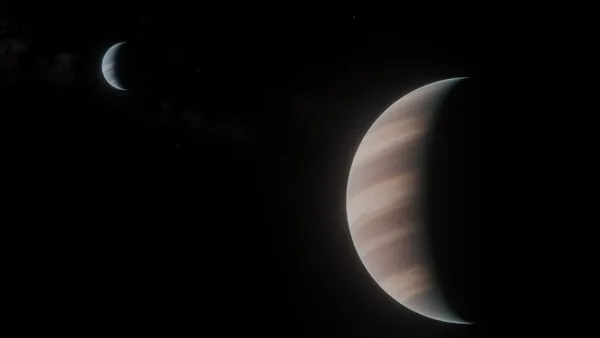
Kepler-1625b is a super-Jupiter exoplanet orbiting the Sun-like star Kepler-1625 about 2,500 parsecs (8,200 light-years) away in the constellation of Cygnus. The large gas giant is approximately the same radius as Jupiter, and orbits its star every 287.4 days. In 2017, hints of a Neptune-sized exomoon in orbit of the planet were found using photometric observations collected by the Kepler Mission. Further evidence for a Neptunian moon was found the following year using the Hubble Space Telescope, where two independent lines of evidence constrained the mass and radius to be Neptune-like. The mass-signature has been independently recovered by two other teams. However, the radius-signature was independently recovered by one of the teams but not the other. The original discovery team later showed that this latter study appears affected by systematic error sources that may have influenced its findings.
Also on this shelf
ADEOS II.
Hurricane Milton.
See also
Uncatalogued shelfText from Wikipedia; plate via Wikimedia Commons. Text CC BY-SA 4.0; plate freely licensed (see Commons). Source record. Images and catalogue data are reproduced from open-access collections.