Astronomy and Space
Abiogenesis
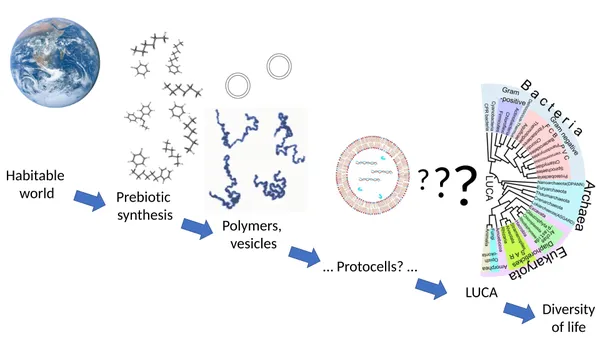
Abiogenesis or the origin of life (sometimes called biopoiesis) is the natural process by which life arises from non-living matter, such as simple organic compounds. The prevailing scientific hypothesis is that the transition from non-living to living entities on Earth was not a single event, but a process of increasing complexity involving the formation of a habitable planet, the prebiotic synthesis of organic molecules, molecular self-replication, self-assembly, autocatalysis, and the emergence of cell membranes. The transition from non-life to life has not been observed experimentally, but many proposals have been made for different stages of the process. The study of abiogenesis aims to determine how pre-life chemical reactions gave rise to life under conditions strikingly different from those on Earth today. It uses tools from biology and chemistry, attempting a synthesis of many sciences. Life functions through the chemistry of carbon and water, and builds on four chemical families: lipids for cell membranes, carbohydrates for chemical energy storage and structural composition, amino acids for protein metabolism, and the nucleic acids DNA and RNA for heredity. A theory of abiogenesis must explain the origins and interactions of these classes of molecules. Many approaches investigate how self-replicating molecules came into existence. Researchers think that life descends from an RNA world, although other self-replicating and self-catalyzing molecules may have preceded RNA. Other approaches ("metabolism-first" hypotheses) focus on how catalysis on the early Earth might have provided the precursor molecules for self-replication. The 1952 Miller–Urey experiment demonstrated that amino acids can be synthesized from inorganic compounds under conditions like early Earth's. Subsequently, amino acids have been found in meteorites, comets, asteroids, and star-forming regions of space. While the last universal common ancestor of all modern organisms (LUCA) existed millions of years after the origin of life, its study can guide research into early universal characteristics. A genomics approach has sought to characterize LUCA by identifying the genes shared by Archaea and Bacteria, major branches of life.
Also on this shelf
Antimatter propulsion spacecraft.
Globular cluster.
See also
Uncatalogued shelfText from Wikipedia; plate via Wikimedia Commons. Text CC BY-SA 4.0; plate freely licensed (see Commons). Source record. Images and catalogue data are reproduced from open-access collections.