Astronomy and Space
Atmosphere of Jupiter
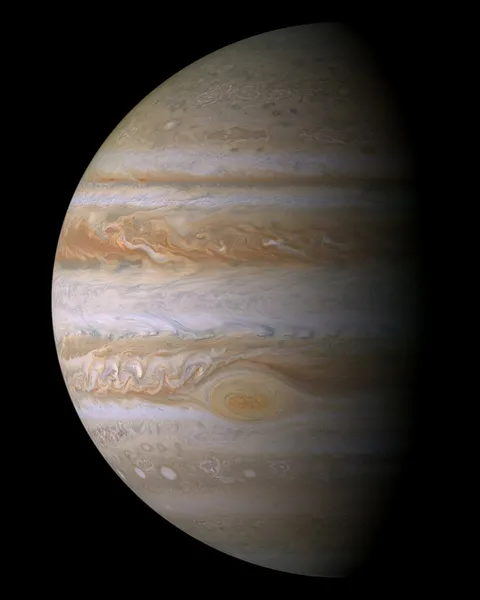
The atmosphere of Jupiter is the largest planetary atmosphere in the Solar System. It is mostly made of molecular hydrogen and helium in roughly solar proportions; other chemical compounds are present only in small amounts and include methane, ammonia, hydrogen sulfide, and water. Although water is thought to reside deep in the atmosphere, its directly-measured concentration is very low. The nitrogen, sulfur, and noble gas abundances in Jupiter's atmosphere exceed solar values by a factor of about three. The atmosphere of Jupiter lacks a clear lower boundary, and gradually transitions into the liquid interior of the planet. From lowest to highest, the atmospheric layers are the troposphere, stratosphere, thermosphere and exosphere. Each layer has characteristic temperature gradients. The lowest layer, the troposphere, has a complicated system of clouds and hazes composed of layers of ammonia, ammonium hydrosulfide, and water. The upper ammonia clouds visible at Jupiter's surface are organized in a dozen zonal bands parallel to the equator and are bounded by powerful zonal atmospheric flows (winds) known as jets, exhibiting a phenomenon known as atmospheric super-rotation. The bands alternate in color: the dark bands are called belts, while light ones are called zones. Zones, which are colder than belts, correspond to upwellings, while belts mark descending gas. The zones' lighter color is believed to result from ammonia ice; what gives the belts their darker colors is uncertain. The origins of the banded structure and jets are not well understood, though a "shallow model" and a "deep model" exist. The Jovian atmosphere shows a wide range of active phenomena, including band instabilities, vortices (cyclones and anticyclones), storms and lightning. The vortices reveal themselves as large red, white or brown spots (ovals). The largest two spots are the Great Red Spot (GRS) and Oval BA, which is also red. These two and most of the other large spots are anticyclonic. Smaller anticyclones tend to be white. Vortices are thought to be relatively shallow structures with depths not exceeding several hundred kilometers. Located in the southern hemisphere, the GRS is the largest known vortex in the Solar System. It could engulf two or three Earths and has existed for at least three hundred years.
Also on this shelf
HTV-X.
7 Draconis.
See also
Uncatalogued shelfText from Wikipedia; plate via Wikimedia Commons. Text CC BY-SA 4.0; plate freely licensed (see Commons). Source record. Images and catalogue data are reproduced from open-access collections.