Astronomy and Space
Kuiper belt
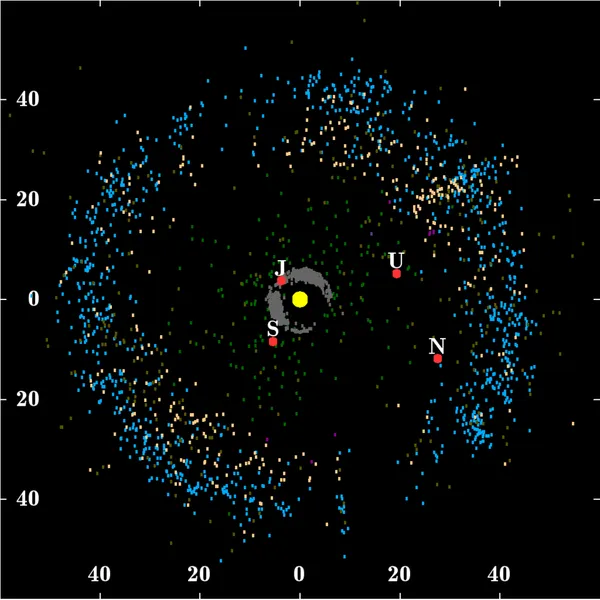
The Kuiper belt ( ) is a circumstellar disc in the outer Solar System, extending from the orbit of Neptune at 30 astronomical units (AU) to approximately 50 AU from the Sun. It is similar to the asteroid belt, but is far larger—20 times as wide and 20–200 times as massive. Like the asteroid belt, it consists mainly of small bodies or remnants from when the Solar System formed. While many asteroids are composed primarily of rock and metal, most Kuiper belt objects are composed largely of frozen volatiles (termed "ices"), such as methane, ammonia, and water. The Kuiper belt is home to most of the objects that astronomers generally accept as dwarf planets: Orcus, Pluto, Haumea, Quaoar, and Makemake. Some of the Solar System's moons, such as Neptune's Triton and Saturn's Phoebe, may have originated in the region. The Kuiper belt is named in honor of the Dutch astronomer Gerard Kuiper, who conjectured the existence of a version of the belt in 1951. There were researchers before and after him who proposed similar hypotheses, such as Kenneth Edgeworth in the 1930s. The most direct prediction of the belt was by astronomer Julio Ángel Fernández, who published a paper in 1980 suggesting the existence of a comet belt beyond Neptune which could serve as a source for short-period comets. In 1992, minor planet 15760 Albion was discovered, the first Kuiper belt object (KBO) since Pluto (in 1930) and Charon (in 1978). Since its discovery, the number of known KBOs has increased to thousands, and more than 100000 KBOs over 100 km (62 mi) in diameter are thought to exist. The Kuiper belt was initially thought to be the main repository for periodic comets, those with orbits lasting less than 200 years. Studies since the mid-1990s have shown that the belt is dynamically stable and that comets' true place of origin is the scattered disc, a dynamically active zone created by the outward motion of Neptune 4.5 billion years ago; scattered-disc objects such as Eris have extremely eccentric orbits that take them as far as 100 AU from the Sun. The Kuiper belt is distinct from the hypothesized Oort cloud, which is believed to be a thousand times more distant and mostly spherical. The objects within the Kuiper belt, together with the members of the scattered disc and any potential Hills cloud or Oort cloud objects, are collectively referred to as trans-Neptunian objects (TNOs).
Also on this shelf
GRB 080916C.
Apollo 14.
See also
Uncatalogued shelfText from Wikipedia; plate via Wikimedia Commons. Text CC BY-SA 4.0; plate freely licensed (see Commons). Source record. Images and catalogue data are reproduced from open-access collections.