Astronomy and Space
Astrophysical X-ray source
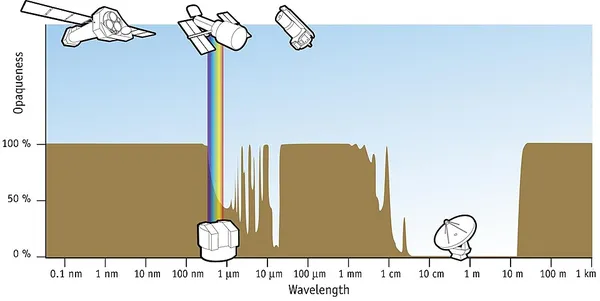
Astrophysical X-ray sources are astronomical objects with physical properties which result in the emission of X-rays. Several types of astrophysical objects emit X-rays. They include galaxy clusters, black holes in active galactic nuclei (AGN), galactic objects such as supernova remnants, stars, and binary stars containing a white dwarf (cataclysmic variable stars and super soft X-ray sources), neutron star or black hole (X-ray binaries). Some Solar System bodies emit X-rays, the most notable being the Moon, although most of the X-ray brightness of the Moon arises from reflected solar X-rays. Furthermore, celestial entities in space are discussed as celestial X-ray sources. The origin of all observed astronomical X-ray sources is in, near to, or associated with a coronal cloud or gas at coronal cloud temperatures for however long or brief a period. A combination of many unresolved X-ray sources is thought to produce the observed X-ray background. The X-ray continuum can arise from bremsstrahlung, either magnetic or ordinary Coulomb, black-body radiation, synchrotron radiation, inverse Compton scattering of lower-energy photons by relativistic electrons, knock-on collisions of fast protons with atomic electrons, and atomic recombination, with or without additional electron transitions.
Also on this shelf
44 Tauri.
Gamma Arietis.
See also
Uncatalogued shelfText from Wikipedia; plate via Wikimedia Commons. Text CC BY-SA 4.0; plate freely licensed (see Commons). Source record. Images and catalogue data are reproduced from open-access collections.