Astronomy and Space
JEDI
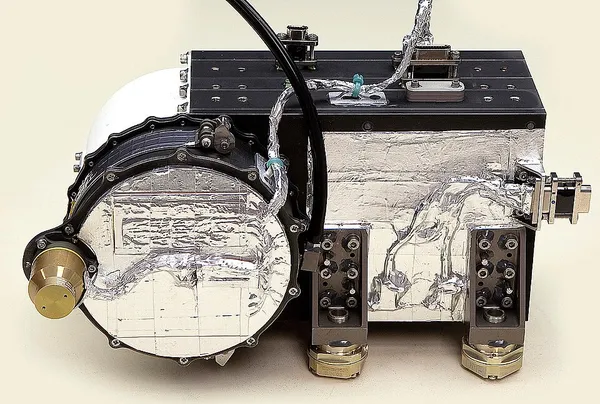
JEDI (Jupiter Energetic-particle Detector Instrument) is an instrument on the Juno spacecraft orbiting planet Jupiter. JEDI coordinates with the several other space physics instruments on the Juno spacecraft to characterize and understand the space environment of Jupiter's polar regions, and specifically to understand the generation of Jupiter's powerful aurora. It is part of a suite of instruments to study the magnetosphere of Jupiter. JEDI consists of three identical detectors that use microchannel plates and foil layers to detect the energy, angle, and types of ion within a certain range. It can detect electrons between 40 and 500 keV (Kilo electron-volts), and hydrogen and oxygen from a few tens of keV to less than 1000 keV (1 MeV). JEDI uses radiation-hardened Application Specific Integrated Circuits (ASIC)s. JEDI was turned on in January 2016 while still en route to Jupiter, to study interplanetary space. JEDI uses solid state detectors (SSDs) to measure the total energy (E) of both the ions and the electrons. The MCP anodes and the SSD arrays are configured to determine the directions of arrivals of the incoming charged particles. The instruments also use fast triple coincidence and optimum shielding to suppress penetrating background radiation and incoming UV foreground. JEDI is designed to collect data on "energy, spectra, mass species (H, He, O, S), and angular distributions"; the plan is to study the energies and distribution of charged particles. It can detect them at between 30 keV and 1 GeV, whereas JADE, another instrument on the spacecraft, is designed to observe below 30 keV. One of the concepts being studied is how energy from Jupiter's rotation is being converted in its atmosphere and magnetosphere. It is radiation-hardened to collect in situ data on the planet's auroral magnetic field lines, the equatorial magnetosphere, and the polar ionosphere. It was built by the Johns Hopkins University Applied Physics Laboratory (APL). One of the goals is to understand the aurorae, and how particles are accelerated to such high speeds. One of the mysteries of Jupiter is that X-rays are emitted from the poles, but do not seem to come from the auroral ring. Each detector has a field of view of 120 degrees by 12 degrees, and they are together positioned to provide a 360-degree (a full circle) view of the sky along that axis.
Also on this shelf
History of the United States Space Force.
Achelous (crater).
See also
Uncatalogued shelfText from Wikipedia; plate via Wikimedia Commons. Text CC BY-SA 4.0; plate freely licensed (see Commons). Source record. Images and catalogue data are reproduced from open-access collections.