Astronomy and Space
Epsilon Persei
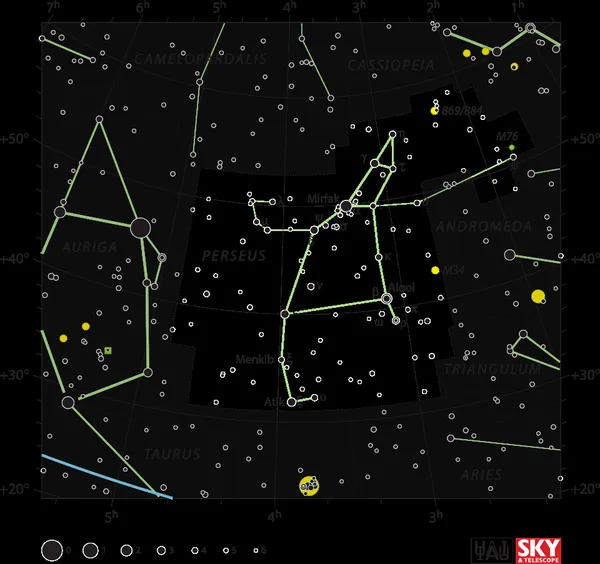
Epsilon Persei, Latinized from ε Persei, formally named Áldu, is a Triple star system in the northern constellation of Perseus. It has a combined apparent visual magnitude of +2.88, which is bright enough to be viewed with the naked eye. Based upon parallax measurements, this system is located at a distance of roughly 640 light-years (196 parsecs) from Earth. This is a spectroscopic binary system, which means that the presence of an orbiting companion has been revealed by radial velocity variations in the spectrum of the primary. The two components are orbiting each other with a period of 14 days at a high orbital eccentricity of 0.55. The secondary component has about 6–13% of the primary's mass and may have a stellar classification in the range from A6 V to K1 V. There may be a third component to this system with an orbital period of roughly 9,428 days (25.8 years), although this has not been conclusively demonstrated. If this component exists, it would have about 51–139% of the primary's mass. This high level of uncertainty is because the inclination of the orbit is not known. The primary component of this system is a massive star with 12–16 times the Sun's mass and near eight times the radius of the Sun. It was chosen as an MK spectral standard for the class B0.5III, making it a giant star that has evolved away from the main sequence. It has also been classified as a main sequence star, reflecting its evolutionary state near or slightly beyind the end of core hydrogen fusion. Component A is radiating over 28,000 times the Sun's luminosity from its outer envelope at an effective temperature of 26,500 K. This gives the star the blue-white hue that is typical of B-type stars. It is also a Beta Cephei variable star with a primary pulsation period of 0.1603 days, or 6.24 cycles per day.
Also on this shelf
Eagle Nebula.
HD 75289.
See also
- ▸David M. Walker (astronaut)
- ▸Ich will den Kreuzstab gerne tragen, BWV 56
- ▸Heat Flow and Physical Properties Package
Text from Wikipedia; plate via Wikimedia Commons. Text CC BY-SA 4.0; plate freely licensed (see Commons). Source record. Images and catalogue data are reproduced from open-access collections.