Astronomy and Space
Apparent magnitude
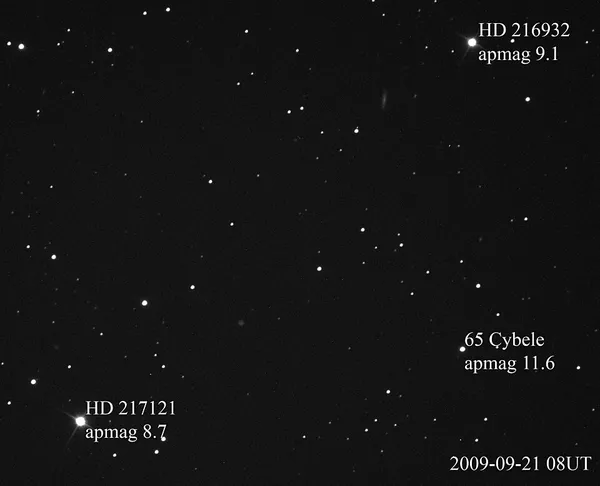
Apparent magnitude (m) is a measure of the brightness of a star, astronomical object or other celestial objects like artificial satellites. Its value depends on its intrinsic luminosity, its distance, and any extinction of the object's light caused by interstellar dust or atmosphere along the line of sight to the observer. Unless stated otherwise, the word magnitude in astronomy usually refers to a celestial object's apparent magnitude. The magnitude scale likely dates to before the ancient Roman astronomer Claudius Ptolemy, whose star catalog popularized the system by listing stars from 1st magnitude (brightest) to 6th magnitude (dimmest). The modern scale was mathematically defined to closely match this historical system by Norman Pogson in 1856. The scale is reverse logarithmic: the brighter an object is, the lower its magnitude number. A difference of 1.0 in magnitude corresponds to the brightness ratio of 100 5 {\displaystyle {\sqrt[{5}]{100}}} , or about 2.512. For example, a magnitude 2.0 star is 2.512 times as bright as a magnitude 3.0 star, 6.31 times as bright as a magnitude 4.0 star, and precisely 100 times as bright as a magnitude 7.0 star. The brightest astronomical objects have negative apparent magnitudes, such as Venus at magnitude −4.2 or Sirius at magnitude −1.46. The faintest stars visible with the naked eye on the darkest night have apparent magnitudes of about +6.5, though this varies depending on a person's eyesight, their altitude, and atmospheric conditions when viewing. The apparent magnitude of known objects can range from −26.832 for our Sun to about +31.5 for objects in deep space imaged by the Hubble Space Telescope. The measurement of apparent magnitude is called photometry. Photometric measurements are made in the ultraviolet, visible, or infrared wavelength bands using standard passband filters belonging to photometric systems such as the UBV system or the Strömgren uvbyβ system. Measurement in the V-band may be referred to as the apparent visual magnitude. Absolute magnitude is a related quantity which measures the luminosity that a celestial object emits, rather than its apparent brightness when observed, and is expressed on the same reverse logarithmic scale.
Also on this shelf
Ganymede (moon).
Ground segment.
See also
Uncatalogued shelfText from Wikipedia; plate via Wikimedia Commons. Text CC BY-SA 4.0; plate freely licensed (see Commons). Source record. Images and catalogue data are reproduced from open-access collections.