Astronomy and Space
Ion thruster
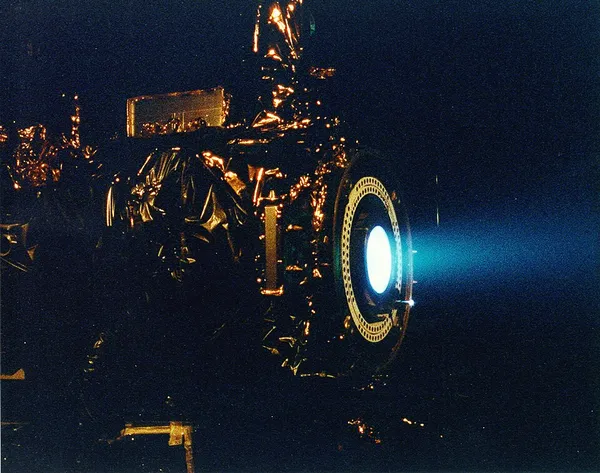
An ion thruster, ion drive, or ion engine is a form of electric propulsion used for spacecraft propulsion. An ion thruster creates a cloud of positive ions from a neutral gas by ionizing it to extract some electrons from its atoms. The ions are then accelerated using electricity to create thrust. Ion thrusters are categorized as either electrostatic or electromagnetic. Electrostatic thruster ions are accelerated by the Coulomb force along the electric field direction. Temporarily stored electrons are reinjected by a neutralizer in the cloud of ions after it has passed through the electrostatic grid, so the gas becomes neutral again and can freely disperse in space without any further electrical interaction with the thruster. By contrast, electromagnetic thruster ions are accelerated by the Lorentz force to accelerate all species (free electrons as well as positive and negative ions) in the same direction whatever their electric charge, and are specifically referred to as plasma propulsion engines, where the electric field is not in the direction of the acceleration. Ion thrusters in operation typically consume 1–7 kW of power, have exhaust velocities around 20–50 km/s (12–30 mi/s, Isp 2000–5000 s), and possess thrusts of 25–250 mN and a propulsive efficiency of 65–80%; experimental ion thrusters have achieved 100 kW (130 hp), 5 N (1.1 lbf). The 1998 Deep Space 1 spacecraft changed velocity by 4.3 km/s (2.7 mi/s) with its ion thruster, and consumed 73.4 kg (162 lb) of xenon. The 2007 Dawn spacecraft achieved velocity change of 11.5 km/s (7.1 mi/s), though with less efficiency, having consumed 425 kg (937 lb) of xenon. Applications include control of the orientation and position of orbiting satellites (some satellites have dozens of low-power ion thrusters), use as a main propulsion engine for low-mass robotic space vehicles (such as Deep Space 1 and Dawn), and serving as propulsion thrusters for crewed spacecraft and space stations (e.g. Tiangong). Ion thrust engines are generally practical only in the vacuum of space as the engine's minuscule thrust cannot overcome any significant air resistance without radical design changes, as may be found in the 'Atmosphere Breathing Electric Propulsion' concept.
Also on this shelf
1 Serpentis.
Beta Camelopardalis.
See also
Uncatalogued shelfText from Wikipedia; plate via Wikimedia Commons. Text CC BY-SA 4.0; plate freely licensed (see Commons). Source record. Images and catalogue data are reproduced from open-access collections.