Astronomy and Space
61 Cygni
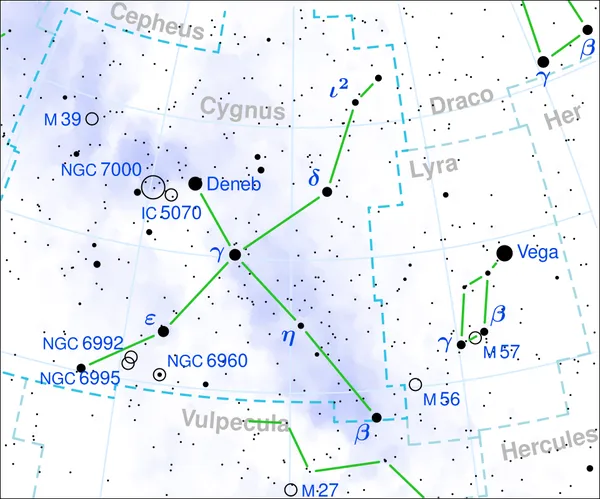
61 Cygni is a binary star system in the northern constellation Cygnus, consisting of a pair of K-type dwarf stars that orbit each other in a period of about 659 years. Of apparent magnitude 5.20 and 6.05, respectively, they can be seen with binoculars in city skies or with the naked eye in rural areas without light pollution. 61 Cygni first attracted the attention of astronomers when its large proper motion was first demonstrated by Giuseppe Piazzi in 1804. In 1838, Friedrich Bessel measured its distance from Earth at about 10.4 light-years, very close to the actual value of about 11.4 light-years; this was the first distance estimate for any star other than the Sun, and the first star to have its stellar parallax measured. Among all stars or stellar systems listed in the latest Gaia catalogues, 61 Cygni has the sixth-highest proper motion, and the highest among all naked-eye visible stars. Over the course of the twentieth century, several different astronomers reported evidence of a massive planet orbiting one of the two stars, but recent high-precision radial velocity observations have shown that all such claims were unfounded. No planets have been confirmed in this stellar system to date.
Also on this shelf
Eta Virginis.
Chandrayaan-2.
See also
Uncatalogued shelfText from Wikipedia; plate via Wikimedia Commons. Text CC BY-SA 4.0; plate freely licensed (see Commons). Source record. Images and catalogue data are reproduced from open-access collections.