Astronomy and Space
Formation of Jupiter
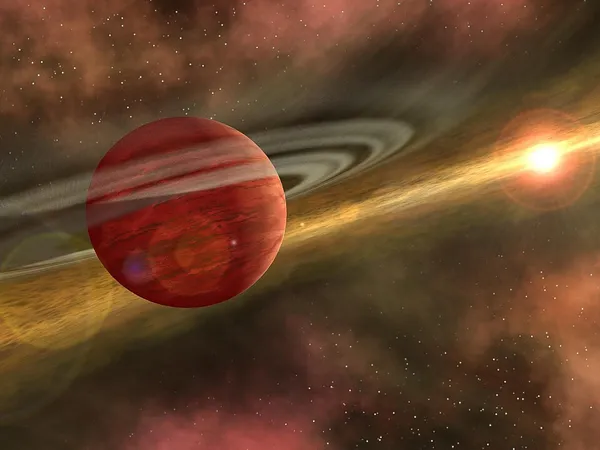
The formation of Jupiter is led by processes that largely follow the same mechanisms by which gas giant planets form according to the solar nebula model. Following the formation of the Sun, which began approximately 4.6 billion years ago, the residual material, rich in metals, formed a circumstellar disk from which planetesimals initially formed, followed by the aggregation of these into protoplanets. Jupiter originated from the coalescence of planetesimals located beyond what planetary scientists call the frost line (astrophysics), a boundary beyond which volatile materials with low melting points condense. The fusion of numerous icy planetesimals gave rise, just beyond the frost line, to a large planetary embryo, which, according to a study published in November 2008, had a mass of approximately 10–18 Earth masses (M⊕). Subsequently, the embryo began to accrete mass rapidly by drawing hydrogen and helium from the gaseous envelope left over from the Sun’s formation, quickly reaching its current mass of 318 M⊕. The accretion process of the planet was mediated by the formation of a circumplanetary disk. Once the volatile materials, which formed the planet’s atmosphere, were depleted, the remaining rocky materials contributed to the formation of the system of satellites orbiting the planet. This system later expanded through the capture of numerous minor bodies due to Jupiter’s strong gravitational pull.
Also on this shelf
Fee, Fi, Fo, Fum, and Phooey.
Cassiopeia (constellation).
See also
Uncatalogued shelfText from Wikipedia; plate via Wikimedia Commons. Text CC BY-SA 4.0; plate freely licensed (see Commons). Source record. Images and catalogue data are reproduced from open-access collections.