Astronomy and Space
21 Lutetia
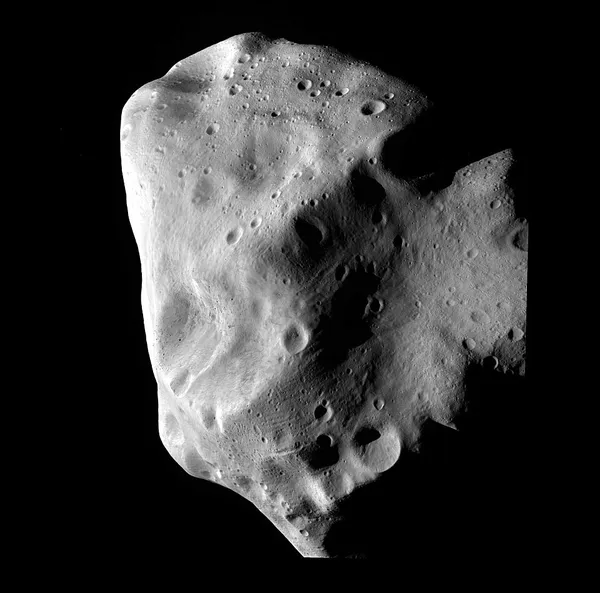
21 Lutetia is a large M-type asteroid in the main asteroid belt. It measures about 100 kilometers in diameter (120 km along its major axis). It was discovered in 1852 by Hermann Goldschmidt, and is named after Lutetia, the Latin name of the city of Paris. Lutetia has an irregular shape and is heavily cratered, with the largest impact crater reaching 45 km in diameter. The surface is geologically heterogeneous and is intersected by a system of grooves and scarps, which are thought to be fractures. It has a high overall bulk density, suggesting that it is made of metal-rich rock. The Rosetta probe passed within 3,162 km (1,965 mi) of Lutetia in July 2010. It was the largest asteroid visited by a spacecraft until Dawn arrived at Vesta in July 2011, and it is currently the 3rd largest asteroid to have ever been imaged in high quality by a spacecraft (after Vesta and Ceres).
Also on this shelf
Astronomical Netherlands Satellite.
Bioastronautics.
See also
Uncatalogued shelfText from Wikipedia; plate via Wikimedia Commons. Text CC BY-SA 4.0; plate freely licensed (see Commons). Source record. Images and catalogue data are reproduced from open-access collections.