Astronomy and Space
Astronomical transit
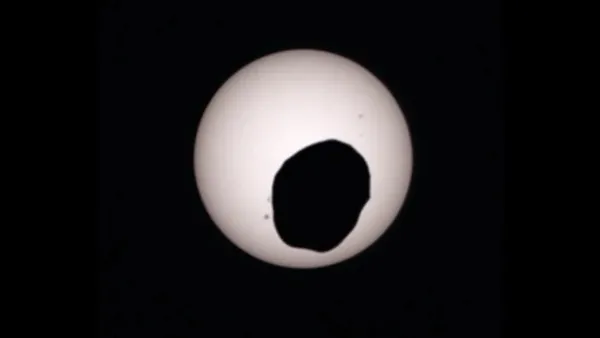
In astronomy, a transit (or astronomical transit) is the passage of a celestial body directly between a larger body and the observer. As viewed from a particular vantage point, the transiting body appears to move across the face of the larger body, covering a small portion of it. The word "transit" refers to cases where the nearer object appears smaller than the more distant object. Cases where the nearer object appears larger and completely hides the more distant object are known as occultations. However, the probability of seeing a transiting planet is low because it is dependent on the alignment of the three objects in a nearly perfectly straight line. Many parameters of a planet and its parent star can be determined based on the transit.
Also on this shelf
Formation of Jupiter.
Barnard's Star.
See also
Uncatalogued shelfText from Wikipedia; plate via Wikimedia Commons. Text CC BY-SA 4.0; plate freely licensed (see Commons). Source record. Images and catalogue data are reproduced from open-access collections.