Astronomy and Space
Center of the universe
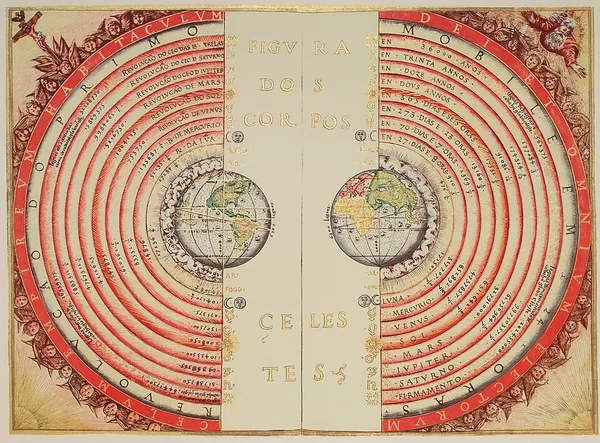
The center of the universe is a concept in historical cosmological models prior to the 20th century. Modern cosmological theories are based on the Copernican principle that all locations are equivalent and the universe has no spatial center. Historically, different people have suggested various locations as the center of the Universe. Many mythological cosmologies included an axis mundi, the central axis of a flat Earth that connects the Earth, heavens, and other realms together. In the 4th century BC Greece, philosophers developed the geocentric model, based on astronomical observation; this model proposed that the center of the Universe lies at the center of a spherical, stationary Earth, around which the Sun, Moon, planets, and stars rotate. With the development of the heliocentric model by Nicolaus Copernicus in the 16th century, the Sun was believed to be the center of the Universe, with the planets (including Earth) and stars orbiting it. In the early-20th century, the discovery of other galaxies and the development of the Big Bang theory led to the development of cosmological models of a homogeneous, isotropic Universe which has no distinct spatial central point because, given that space expands from a shared central point in time (the Big Bang), the center of the universe is everywhere.
Also on this shelf
Exploration of Titan.
Infrared Space Observatory.
See also
Uncatalogued shelfText from Wikipedia; plate via Wikimedia Commons. Text CC BY-SA 4.0; plate freely licensed (see Commons). Source record. Images and catalogue data are reproduced from open-access collections.