Asian Art
Iron Age
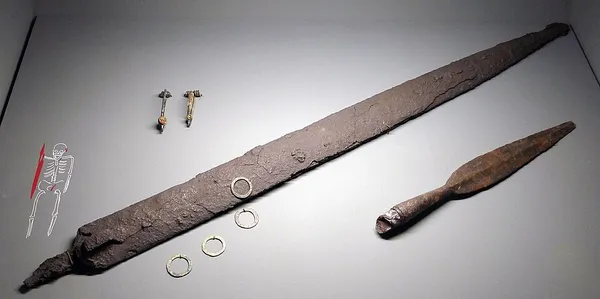
The Iron Age is the final epoch of the three-age system of technology after the Copper Age and Bronze Age. It has also been considered as the final age of the three-age division starting with prehistory (before recorded history) and progressing to protohistory (before written history). In this usage, it is preceded by the Stone Age (subdivided into the Paleolithic, Mesolithic and Neolithic) and Bronze Age. These concepts originated for describing Iron Age Europe and the ancient Near East. In the archaeology of the Americas, a five-period system is conventionally used instead; indigenous cultures there did not develop an iron economy in the pre-Columbian era, though some did work copper and silver. Indigenous metalworking arrived in Australia with European contact. Although meteoric iron has been used for millennia in many regions, the beginning of the Iron Age is defined locally around the world by archaeological convention when the production of smelted iron (especially steel tools and weapons) replaces their bronze equivalents in common use. However, this notion is being challenged. In Anatolia and the Caucasus, or Southeast Europe, the Iron Age began c. 1300 BC. In the ancient Near East, this transition occurred simultaneously with the Late Bronze Age collapse, during the 12th century BC. The technology soon spread throughout the Mediterranean basin region and to South Asia between the 12th and 11th centuries BC. Its further spread to Central Asia, Eastern Europe, and Central Europe was somewhat delayed, and Northern Europe was not reached until c. the 5th century BC. The Iron Age in India is stated as beginning with the ironworking Painted Grey Ware culture, dating from c. 1200 BC to the reign of Ashoka in the 3rd century BC. The term "Iron Age" in the archaeology of South, East, and Southeast Asia is more recent and less common than for western Eurasia. Africa did not have a universal "Bronze Age", and many areas transitioned directly from stone to iron.
Also on this shelf
Civilized drama.
Haiti.
See also
Uncatalogued shelfText from Wikipedia; plate via Wikimedia Commons. Text CC BY-SA 4.0; plate freely licensed (see Commons). Source record. Images and catalogue data are reproduced from open-access collections.