Asian Art
Angkor
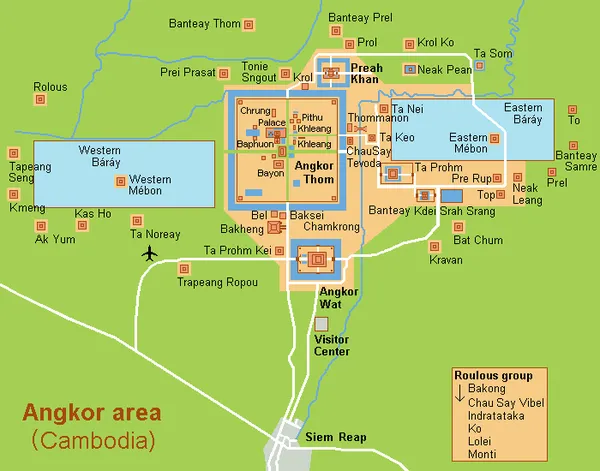
Angkor (Khmer: អង្គរ [ʔɑŋkɔː], lit. 'capital city'), also known as Yasodharapura (Khmer: យសោធរបុរៈ; Sanskrit: यशोधरपुर), was the capital city of the Khmer Empire, located in present-day Cambodia. The empire flourished from approximately the 9th to the 15th centuries. The site of Angkor has a variety of religious temples, libraries, moats, and other buildings. These other buildings could have been used by officials to the grand palace housing the Khmer king. Those constructed outside the main complex were not made of stone. One of the more visited places in Angkor is Angkor Wat, a temple complex that is one of Cambodia's tourist attractions. The name Angkor is derived from nokor (នគរ), a Khmer word meaning "kingdom" which in turn derived from Sanskrit nagara (नगर), meaning "city". The Angkorian period began in AD 802, when the Khmer Hindu monarch Jayavarman II declared himself a "universal monarch" and "god-king", and lasted until the late 14th century, first falling under Ayutthayan suzerainty in 1351. A Khmer rebellion against Siamese authority resulted in the 1431 sacking of Angkor by Ayutthaya, causing its population to migrate south to Longvek. The alternate name, Yasodharapura, was derived from the name of the foster mother of Lord Krishna in Hinduism this temple was completed around 921. Hinduism was the dominant religion in the ancient Khmer Empire, and many temples constructed by Khmer kings were dedicated to Hindu deities, including Angkor Wat. The ruins of Angkor are located amid forests and farmland north of the Great Lake (Tonlé Sap) and south of the Kulen Hills, near modern-day Siem Reap city (13°24′N, 103°51′E), in Siem Reap Province. The temples in the Angkor area sum to over one thousand, including Angkor Wat, is a large religious monument. Many of the temples at Angkor held a variety of religious beliefs, including Shaivite, Buddhist, and Vaishnavite, and many others. Together, they comprise the most significant site of Khmer architecture. Visitors approach two million annually. Angkor was declared a UNESCO World Heritage Site in 1992. This increases their ability to conserve the site for future generations.
Also on this shelf
Chiang Kai-shek Memorial Hall.
Culture of Asia.
See also
Uncatalogued shelfText from Wikipedia; plate via Wikimedia Commons. Text CC BY-SA 4.0; plate freely licensed (see Commons). Source record. Images and catalogue data are reproduced from open-access collections.