Asian Art
Elam
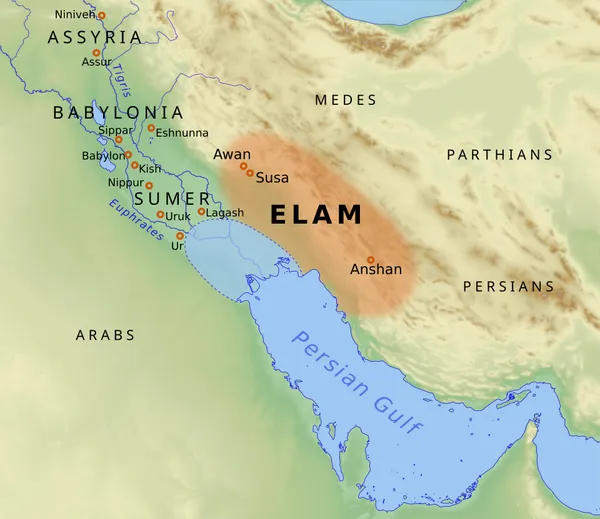
Elam () was an ancient civilization centered in the far west and southwest of Iran, stretching from the lowlands of Ilam and Khuzestan as well as a small part of modern-day southern Iraq. The modern name Elam stems from the Sumerian transliteration elam(a), along with the later Akkadian elamtu, and the Elamite haltamti. Elamite states were among the leading political forces of the Ancient Near East. In classical literature, Elam was also known as Susiana (US: UK: ; Ancient Greek: Σουσιανή Sousiānḗ), a name derived from its capital Susa. Elam was part of the early urbanization of the Near East during the Chalcolithic period (Copper Age). The emergence of written records from around 3000 BC also parallels Sumerian history, where slightly earlier records have been found. In the Old Elamite period (Middle Bronze Age), Elam consisted of kingdoms on the Iranian plateau, centered in Anshan, and from the mid-2nd millennium BC, it was centered in Susa in the Khuzestan lowlands. The Elamites played an important role in the development of Iranian civilization. Their administrative traditions and organized government were an important foundation of the Iranian administrative system.
Also on this shelf
Conservation and restoration of woodblock prints.
Ann Hui.
See also
Uncatalogued shelfText from Wikipedia; plate via Wikimedia Commons. Text CC BY-SA 4.0; plate freely licensed (see Commons). Source record. Images and catalogue data are reproduced from open-access collections.