Asian Art
Iznik pottery
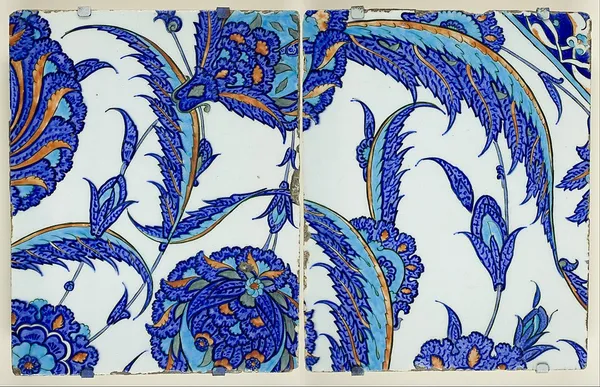
Iznik pottery, or Iznik ware, named after the town of İznik in Anatolia where it was made, is a decorated ceramic that was produced from the last quarter of the 15th century until the end of the 17th century. The Ottoman Turkish motivation for creating İznik ware was to imitate the prestige and symbolic value of Chinese porcelain, not its specific decorative designs. While their conceptual origin lies in Chinese blue-and-white porcelain, their decorative design is a distinct Ottoman adaptation of the International Timurid style. This adaptation is marked by a transformation from the prototype's languid quality to a more forceful and contained design, distinguished by its intensity and three-dimensional feel. Technologically, these wares are unique, differing from the methods used for contemporary Iranian pottery and Ottoman architectural tilework. This distinct manufacturing process is thought to be an invention of Anatolian potters. İznik was an established centre for the production of simple earthenware pottery with an underglaze decoration when, in the last quarter of the 15th century, craftsmen in the town began to manufacture high quality pottery with a fritware body painted with cobalt blue under a colourless transparent lead glaze. The change was almost certainly a result of active intervention and patronage by the recently established Ottoman court in Istanbul who greatly valued Chinese blue-and-white porcelain. During the 16th century the decoration of the pottery gradually changed in style, becoming looser and more flowing. Additional colours were introduced. Initially turquoise was combined with the dark shade of cobalt blue and then the shades of piney green and pale purple were added. From the middle of the century the potters in Iznik produced large quantities of underglazed tiles to decorate the imperial buildings designed by the architect Mimar Sinan. Associated with the production of tiles was the introduction of a very characteristic bole red to replace the purple and a bright emerald green to replace the sage green. From the last decade of the century there was a marked deterioration in quality and although production continued during the 17th century the designs were poor.
Also on this shelf
Hokusai.
Chopsticks.
See also
Uncatalogued shelfText from Wikipedia; plate via Wikimedia Commons. Text CC BY-SA 4.0; plate freely licensed (see Commons). Source record. Images and catalogue data are reproduced from open-access collections.