Asian Art
History of the Han dynasty
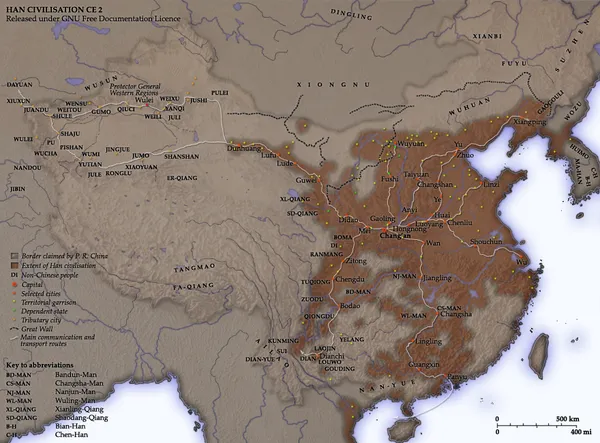
The Han dynasty (201 BCE – 220 CE) was the second imperial dynasty of China. It followed the Qin dynasty, which had unified the Warring States of China by conquest. It was founded by Liu Bang (Emperor Gaozu). The dynasty is divided into two periods: the Western Han (202 BCE – 9 CE) and the Eastern Han (25–220 CE), interrupted briefly by the Xin dynasty (9–23 CE) of Wang Mang. These appellations are derived from the locations of the capital cities Chang'an and Luoyang, respectively. The third and final capital of the dynasty was Xuchang, where the court moved in 196 CE during a period of political turmoil and civil war. The Han dynasty ruled in an era of Chinese cultural consolidation, political experimentation, relative economic prosperity and maturity, and great technological advances. There was unprecedented territorial expansion and exploration initiated by struggles with non-Chinese peoples, especially the nomadic Xiongnu of the Eurasian Steppe. The Han emperors were initially forced to acknowledge the rival Xiongnu Chanyus as their equals, yet in reality the Han was an inferior partner in a tributary and royal marriage alliance known as heqin. This agreement was broken when Emperor Wu of Han (r. 141–87 BCE) launched a series of military campaigns which eventually caused the fissure of the Xiongnu Federation and redefined the borders of China. The Han realm was expanded into the Hexi Corridor of modern Gansu, the Tarim Basin of modern Xinjiang, modern Yunnan and Hainan, modern northern Vietnam, modern North Korea, and southern Outer Mongolia. The Han court established trade and tributary relations with rulers as far west as the Arsacids, to whose court at Ctesiphon in Mesopotamia the Han monarchs sent envoys. Buddhism first entered China during the Han, spread by missionaries from Parthia and the Kushan Empire of northern India and Central Asia. From its beginning, the Han imperial court was threatened by plots of treason and revolt from its subordinate kingdoms, eventually ruled only by royal Liu family members. Initially, the eastern half of the empire was indirectly administered through large semi-autonomous kingdoms which pledged loyalty and a portion of their tax revenues to the Han emperors, who ruled directly over the western half of the empire from Chang'an.
Also on this shelf
Baltimore Museum of Art.
Anglo-Soviet invasion of Iran.
See also
Uncatalogued shelfText from Wikipedia; plate via Wikimedia Commons. Text CC BY-SA 4.0; plate freely licensed (see Commons). Source record. Images and catalogue data are reproduced from open-access collections.