Asian Art
Arab Cold War
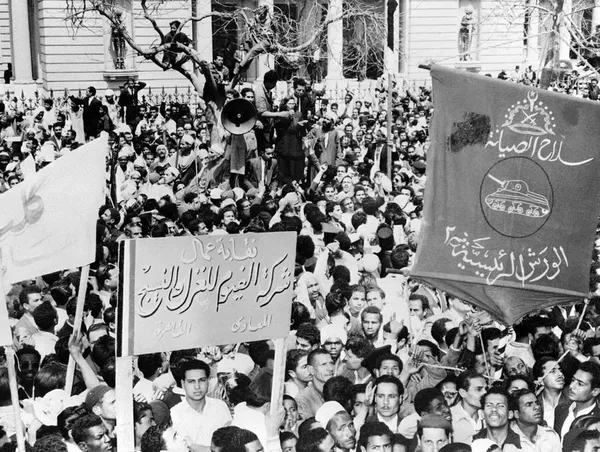
The Arab Cold War (Arabic: الحرب العربية الباردة al-ḥarb al-`arabiyyah al-bāridah) was a political rivalry in the Arab world from the early 1950s to the late 1970s or early 1990s and a part of the wider Cold War. It is generally accepted that the beginning of the Arab Cold War is marked by the Egyptian Revolution of 1952, which led to Gamal Abdel Nasser becoming the president of Egypt in 1956. Thereafter, newly formed Arab republics, inspired by revolutionary secular nationalism and Nasser's Egypt, engaged in political rivalries with conservative traditionalist Arab monarchies, influenced by Saudi Arabia. The Iranian Revolution of 1979, and the ascension of Ayatollah Ruhollah Khomeini as leader of Iran, is widely seen as the end of this period of internal conflicts and rivalry. A new era of Arab-Iranian tensions followed, overshadowing the bitterness of intra-Arab strife. Nasser espoused secular pan-Arab nationalism and socialism as a response to the perceived complicity of the Arab monarchies in Western interference in the Arab world. He also opposed the monarchies' support of rentierism and Islamism. Later Nasser embraced the Palestinian cause, albeit within the framework of pan-Arabism. After Egypt's political victory in the 1956 Suez Crisis, known in the Arab world as the Tripartite Aggression, Nasser and his associated ideology quickly gained support in other Arab countries, from Iraq in the east to French-occupied Algeria in the west. In several Arab countries, such as Iraq, North Yemen and Libya, conservative regimes were overthrown and replaced by new, ‘revolutionary’ republican governments. Meanwhile, Arab countries under Western countries’ rule, such as Algeria and South Yemen, experienced nationalist uprisings aimed at independence. At the same time, Syria, which was already strongly Arab nationalist, formed a short-lived federal union with Egypt called the United Arab Republic. Several other attempts were made to unite the Arab states in various configurations, but all attempts were unsuccessful. Following their independence, the monarchies of Saudi Arabia, Jordan and Morocco, as well as the Gulf states, formed an alliance to directly or indirectly counter Egyptian influence.
Also on this shelf
History of the Jews in Zambia.
Federal Department of Foreign Affairs.
See also
Uncatalogued shelfText from Wikipedia; plate via Wikimedia Commons. Text CC BY-SA 4.0; plate freely licensed (see Commons). Source record. Images and catalogue data are reproduced from open-access collections.