Asian Art
Guang (vessel)
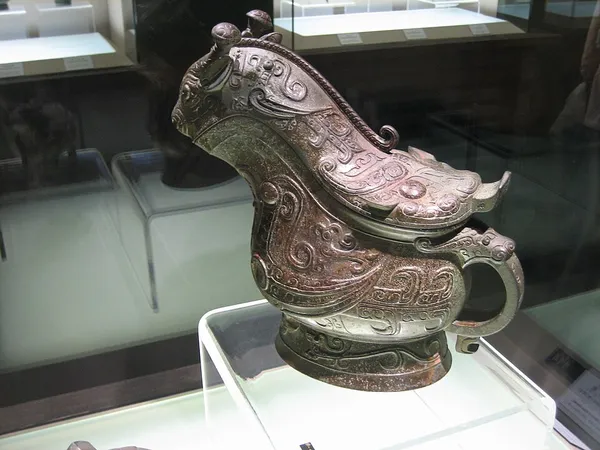
A guang or gong is a particular shape used in Chinese art for vessels, originally made as Chinese ritual bronzes in the Shang dynasty (c. 1600 – c. 1046 BCE), and sometimes later in Chinese porcelain. They are a type of pitcher which was used for pouring rice wine at ritual banquets, and often deposited as grave goods in high-status burial. Examples of the shape may be described as ewers, ritual wine vessels, wine pourers and similar terms, though all of these terms are also used of a number of other shapes, especially the smaller tripod jue and the larger zun. The guang has a single thick foot, and a thick hollow body that represents one or more stylized animals (some have a head at both ends). Guangs have a vertical handle at one end and a spout at the other, both zoomorphic, and were often highly decorated with taotie. The handle of the guang is of often in the shape of the neck and head of an animal with stylized horns, and the spout of the vessel is in the form of the head of a creature whose mouth constitutes the end of the spout. The back and animal head at the pouring end usually are a removable lid, lifted off for pouring. Their main period of use was during the Shang and Zhou dynasties, from around 1700 to 900 BCE; thereafter the shape was sometimes used in a revivalist spirit. The Ritual wine server (guang), Indianapolis Museum of Art, 60.43 is a fine example from about 1100 BCE.
Also on this shelf
1st millennium.
History of Japan–Korea relations.
See also
Uncatalogued shelfText from Wikipedia; plate via Wikimedia Commons. Text CC BY-SA 4.0; plate freely licensed (see Commons). Source record. Images and catalogue data are reproduced from open-access collections.