Asian Art
Andronovo culture
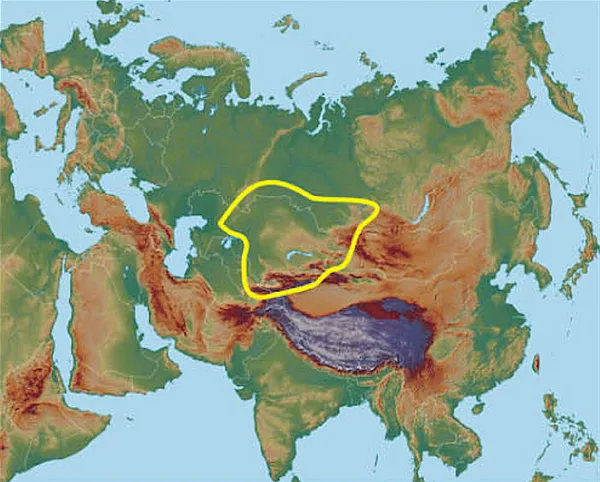
The Andronovo culture is a collection of similar local Late Bronze Age cultures that flourished c. 2000–1150 BC, spanning from the southern Urals to the upper Yenisei River in central Siberia and western Xinjiang in the east. In the south, the Andronovo sites reached Tajikistan and Uzbekistan. It is agreed among scholars that the Andronovo culture was Indo-Iranian. Some researchers have preferred to term it an archaeological complex or archaeological horizon. Andronovo culture's first stage may have started as early as the waning years of the 3rd millennium BC, with a focus on cattle grazing in the vast grasslands of the region. The slightly older Sintashta culture (c. 2200–1900 BC), formerly included within the Andronovo culture, is now thought to be distinct from Early Andronovo cultures. Allentoft et al. (2015) concluded from their genetic studies that the Andronovo culture and the preceding Sintashta culture were derived from an eastern migration of the Corded Ware culture, given the higher proportion of ancestry matching the earlier farmers of Europe, similar to the admixture found in the genomes of the Corded Ware population.
Also on this shelf
Acupuncture.
Carved lacquer.
See also
Uncatalogued shelfText from Wikipedia; plate via Wikimedia Commons. Text CC BY-SA 4.0; plate freely licensed (see Commons). Source record. Images and catalogue data are reproduced from open-access collections.