Asian Art
East Asian hip-and-gable roof
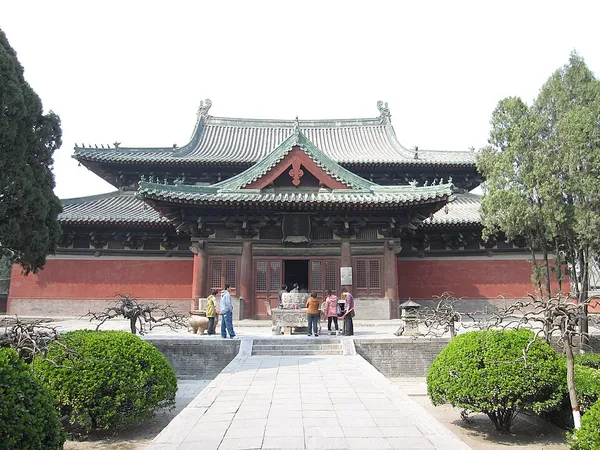
The East Asian hip-and-gable roof (Xiēshān (歇山) in Chinese, Paljakjibung (팔작지붕) in Korean and Irimoya (入母屋) in Japanese) also known as 'resting hill roof', consists of a hip roof that slopes down on all four sides and integrates a gable on two opposing sides. It is usually constructed with two large sloping roof sections in the front and back respectively, while each of the two sides is usually constructed with a smaller roof section. The style is Chinese in origin, and has spread across much of East and Continental Asia. The original Chinese style and similar styles are not only found in the traditional architectures of Japan, Korea, and Vietnam but also other countries such as Mongolia, Buryatia, Kalmykia, Tuva, Bhutan, Tibet and Sri Lanka. A similar, generally taller and originally thatched hip and gable style is also traditionally used in Southeast Asia such as in the Philippines and in Indonesia.
Also on this shelf
Brahmā (Buddhism).
Giani.
See also
Uncatalogued shelfText from Wikipedia; plate via Wikimedia Commons. Text CC BY-SA 4.0; plate freely licensed (see Commons). Source record. Images and catalogue data are reproduced from open-access collections.