Asian Art
Japanese dry garden
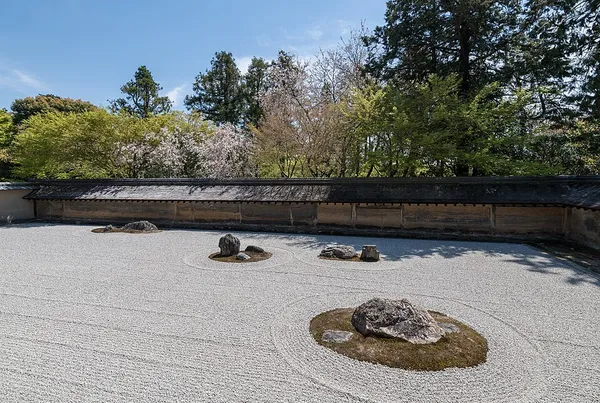
The Japanese dry garden (枯山水, karesansui) or Japanese rock garden, often called a Zen garden, is a distinctive style of Japanese garden. It creates a miniature stylized landscape through carefully composed arrangements of rocks, water features, moss, pruned trees and bushes, and uses gravel or sand that is raked to represent ripples in water. Zen gardens are commonly found at temples or monasteries. A Zen garden is usually relatively small, surrounded by a wall or buildings, and is usually meant to be seen while seated from a single viewpoint outside the garden, such as the porch of the hojo, the residence of the chief monk of the temple or monastery. Many, with gravel rather than grass, are only stepped into for maintenance. Classical Zen gardens were created at temples of Zen Buddhism in Kyoto during the Muromachi period. They were intended to imitate the essence of nature, not its actual appearance, and to serve as an aid for meditation.
Also on this shelf
Baba Deep Singh.
History of Buddhism in India.
See also
Uncatalogued shelfText from Wikipedia; plate via Wikimedia Commons. Text CC BY-SA 4.0; plate freely licensed (see Commons). Source record. Images and catalogue data are reproduced from open-access collections.