Asian Art
Chakma people
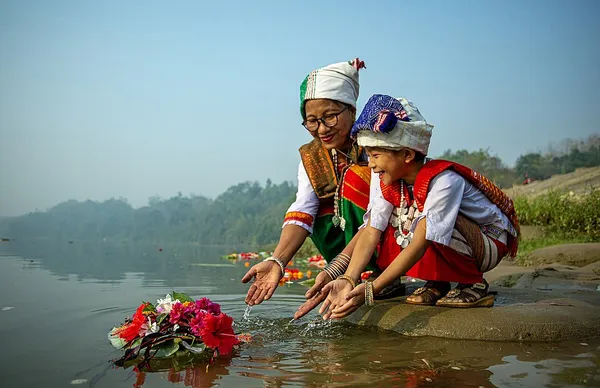
The Chakma, or Changhma people (Chakma: 𑄌𑄋𑄴𑄟𑄳𑄦, 𑄌𑄇𑄴𑄟), are an ethnic group and nation native to the Indian subcontinent and western Myanmar. They are the largest indigenous group as well as the second largest ethnic group of the Chittagong Hill Tracts region of southeastern Bangladesh. They also form the majority in Chakma Autonomous District Council of Mizoram. Significant Chakma populations are found in the northeast Indian states of Arunachal Pradesh, Tripura, Assam and Rakhine State of Myanmar. The Chakma possess strong ethnic affinities to Tibeto-Burman-speaking groups in Northeast India. Due to a historical language shift aimed at consolidating intertribal power, the Chakma adopted the Indo-Aryan Chakma language, which is closely related to Pali and to the Chittagonian language spoken in adjacent regions. Most modern Chakma people practice Theravada Buddhism, due to 19th-century reforms and institutionalisation by Queen regnant Rani Kalindi. In Myanmar, Chakma people are known as Daingnet and are one of the 135 officially recognised ethnic groups in Myanmar. They are also referred as "Saks", "Sakmas" or "Tsakmas". The Chakmas are divided into 31 clans or gozas. The community is headed by the Chakma Raja, whose status as a tribal head has been historically recognised by the government of British India and the government of Bangladesh.
Also on this shelf
Faisalabad.
History of the Jews in Bolivia.
See also
Uncatalogued shelfText from Wikipedia; plate via Wikimedia Commons. Text CC BY-SA 4.0; plate freely licensed (see Commons). Source record. Images and catalogue data are reproduced from open-access collections.