Asian Art
Garuda
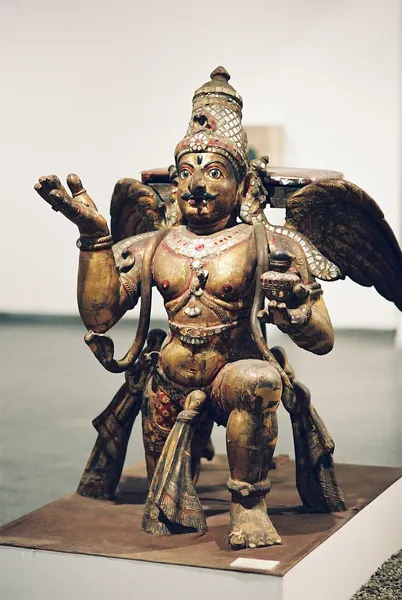
Garuda (Sanskrit: गरुड, romanized: Garuḍa; Pali: गरुळ, romanized: Garuḷa) is a Hindu deity who is primarily depicted as the mount (vahana) of the Hindu god Vishnu. This divine creature is mentioned in the Hindu, Buddhist, and Jain faiths. Garuda is also the half-brother of the Devas, Gandharvas, Daityas, Danavas, Nāgas, Vanaras and Yakshas. He is the son of the sage Kashyapa and Vinata. He is the younger brother of Aruna, the charioteer of the Sun. Garuda is mentioned in several other texts such as the Puranas and the Vedas. Garuda is described as the king of the birds and a kite-like figure. He is shown either in a zoomorphic form (a giant bird with partially open wings) or an anthropomorphic form (a man with wings and some bird-like features). Garuda is generally portrayed as a protector with the power to swiftly travel anywhere, ever vigilant and an enemy of every serpent. He is also known as Tarkshya and Vainateya. Garuda is a part of the state insignia of India, Indonesia and Thailand. Both Indonesia and Thailand have Garuda as their coat of arms, and the Indian Army uses the Garuda on its Guards Brigade Regimental Insignia. The Indian Air Force named their special operations unit after him as the Garud Commando Force. The name Garuda is often associated with the Greater adjutant stork (Leptoptilos dubius).
Also on this shelf
Chinese painting.
Anglo-Japanese style.
See also
Uncatalogued shelfText from Wikipedia; plate via Wikimedia Commons. Text CC BY-SA 4.0; plate freely licensed (see Commons). Source record. Images and catalogue data are reproduced from open-access collections.