Asian Art
14th Dalai Lama
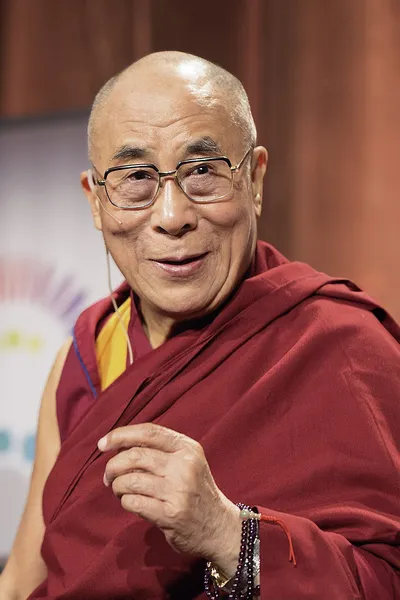
The 14th Dalai Lama (born Lhamo Thondup, 6 July 1935; full spiritual name: Jetsun Jamphel Ngawang Lobsang Yeshe Tenzin Gyatso, shortened as Tenzin Gyatso) is the current Dalai Lama, the highest spiritual leader and head of Tibetan Buddhism. He served as the resident spiritual and temporal leader of Tibet before 1959, and subsequently led the Tibetan government in exile represented by the Central Tibetan Administration in Dharamshala, India. A belief central to the Tibetan Buddhist tradition as well as the institution of the Dalai Lama is that the reincarnated person is a living Bodhisattva, specifically an emanation of Avalokiteśvara (in Sanskrit) or Chenrezig (in Tibetan), the Bodhisattva of Compassion. The Mongolic word dalai means ocean. The 14th Dalai Lama is also known to Tibetans as Gyalwa Rinpoche ("The Precious Jewel-like Buddha-Master"), Kundun ("The Presence"), and Yizhin Norbu ("The Wish-Fulfilling Gem"). His devotees, as well as much of the Western world, often call him His Holiness the Dalai Lama. He is the leader and a monk of the newest Gelug school of Tibetan Buddhism. The 14th Dalai Lama was born to a farming family in Taktser (Hongya village), in the traditional Tibetan region of Amdo, at the time a Chinese frontier district. He was selected as the tulku of the 13th Dalai Lama in 1937, and formally recognised as the 14th Dalai Lama in 1939. As with the recognition process for his predecessor, a Golden Urn selection process was waived and approved by the Nationalist government of China. His enthronement ceremony was held in Lhasa on 22 February 1940. Following the Battle of Chamdo, in which PRC forces annexed Central Tibet, the Tibetan government, the Ganden Phodrang, invested the Dalai Lama with temporal duties on 17 November 1950 (at 15 years of age), which he held until his exile in 1959. During the 1959 Tibetan uprising, the Dalai Lama escaped to India, where he continues to live. On 29 April 1959, the Dalai Lama established the independent Tibetan government in exile in the north Indian hill station of Mussoorie, which then moved in May 1960 to Dharamshala, where he resides. He retired as political head in 2011 to make way for a democratic government, the Central Tibetan Administration.
Also on this shelf
Four Great Inventions.
Christianity in China.
See also
Uncatalogued shelfText from Wikipedia; plate via Wikimedia Commons. Text CC BY-SA 4.0; plate freely licensed (see Commons). Source record. Images and catalogue data are reproduced from open-access collections.