Asian Art
Dvaravati
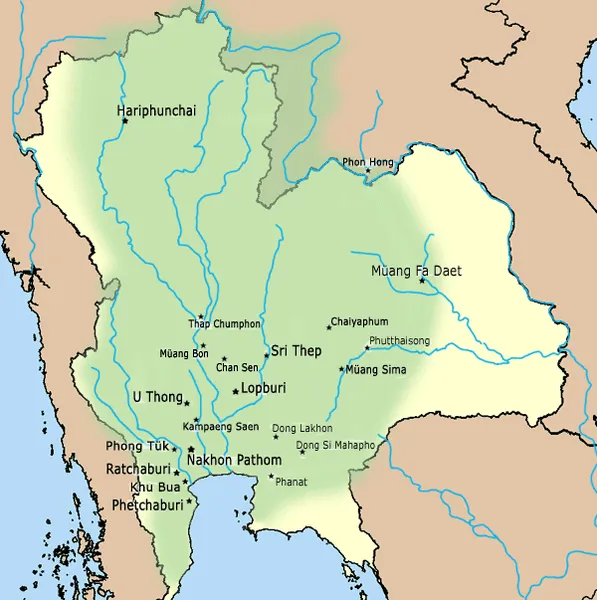
Dvaravati is the conventional name for a network of early historic polities in present-day central Thailand, dated from about the 6th to the 11th century; archaeological evidence places the beginnings of its culture several centuries earlier, in a phase usually called Proto-Dvaravati. What Dvāravatī actually was is still not clear. Scholars have described it as a kingdom, a group of regional polities, a chiefdom, a changing mandala of political power, a collection of smaller peer polities, or even more generally as a shared artistic and religious tradition instead of one political state. These different interpretations are partly because the archaeological evidence is uneven, especially for ordinary settlements and reliably dated evidence, and partly because art historians and archaeologists approach the evidence in different ways. As a result, the political organization, chronology, territory, and extent of cultural unity are still debated. The term covers a cultural and artistic sphere wider than any political entity, and a shared material culture does not by itself imply a single ethnic group. Mid-7th-century Chinese Buddhist accounts place a kingdom called To-lo-po-ti west of Isanapura, east of Sri Ksetra and north of Pan Pan. To the north it bordered Jiā Luó Shě Fú (迦逻舍佛), identified with Canasapura in the upper Mun-Chi basin and with Si Thep in the Pa Sak basin. Embassies to the Chinese court are recorded in 583, around 605–616, in 638, 640, 643, 647, and 649. Baker and Pasuk, and Murphy after Robert L. Brown, count three under that name: 638, 640 and 649. Mon communities, perhaps including maritime traders, are thought to have carried the culture into the Chao Phraya valley by the early centuries CE. That followed the transitional Proto-Dvaravati phase associated with principalities such as Chin Lin and Tun Sun in the western plains and Tou Yuan to the east, a phase usually dated to the 1st to 5th centuries, though Stephen A. Murphy limits it to the 4th and 5th. Dvaravati's early political centre is disputed. Proposed centres include Ayojjhapura (Si Thep), Sambuka (Nakhon Pathom), and Avadhyapura (Si Mahosot). By the mid-7th century, prominence appears to have shifted to Lavo's Lavapura, following the absorption of Tou Yuan in 647.
Also on this shelf
Baba Deep Singh.
Kingdom of Kush.
See also
Uncatalogued shelfText from Wikipedia; plate via Wikimedia Commons. Text CC BY-SA 4.0; plate freely licensed (see Commons). Source record. Images and catalogue data are reproduced from open-access collections.