Asian Art
Ishikawa Toyonobu
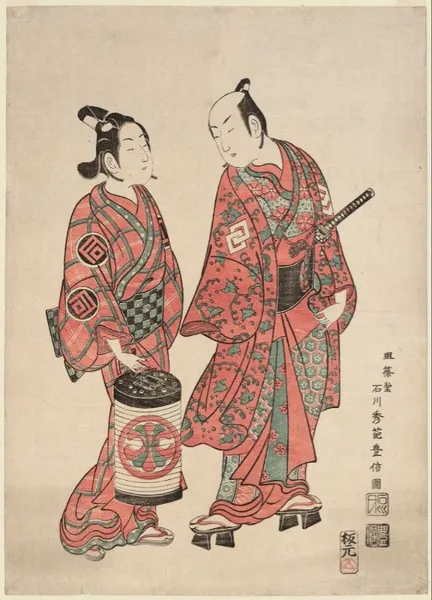
Ishikawa Toyonobu (石川 豊信; 1711 – July 1, 1785) was a Japanese ukiyo-e print artist. He is sometimes said to have been the same person as Nishimura Shigenobu, a contemporary ukiyo-e artist and student of Nishimura Shigenaga about whom very little is known. His earliest works are indeed signed "Nishimura Magosaburō Shigenobu"; he only later adopted the gō Tanshōdō, Meijōdō and Shūha. A pupil of Nishimura Shigenaga, Toyonobu produced many monochrome "lacquer prints" (urushi-e) which reflected the influence of Okumura Masanobu as well. During the 1730s and 1740s he produced numerous yakusha-e and bijinga in this style, and went on to found the Ishikawa Toyonobu school in Kyoto. Many of these were yakusha-e (actor prints) and bijin-ga (images of beautiful women), including images of standing courtesans, whose faces conveyed an impassivity typical of the works of the Kaigetsudō school. Toyonobu also experimented with semi-nude forms, something his chief predecessors also did, but never succeeded in developing it into a trend or subgenre within ukiyo-e. Art historian Richard Lane points out that these images, depicting women with the top half of their kimono open and let down to reveal their chests, were intended as suggestive and erotic, and were not "glorification of the human form such as we find in Greek art". Later in his career, Toyonobu became one of the leading producers of color prints, chiefly benizuri-e ("rose prints"), but stopped producing ukiyo-e shortly after Suzuki Harunobu pioneered the full-color print (nishiki-e) in 1765. He had one notable pupil, Ishikawa Toyomasa, who is known chiefly for his depictions of children at play, and who may have been Toyonobu's son.
Also on this shelf
History of the Jews in Monaco.
Energy in Armenia.
See also
Uncatalogued shelfText from Wikipedia; plate via Wikimedia Commons. Text CC BY-SA 4.0; plate freely licensed (see Commons). Source record. Images and catalogue data are reproduced from open-access collections.