Asian Art
Dream of the Red Chamber
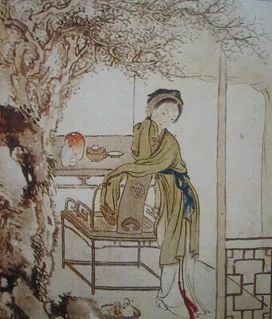
Dream of the Red Chamber (simplified Chinese: 红楼梦; traditional Chinese: 紅樓夢; pinyin: hónɡ lóu mènɡ, also translated as Red Chamber Dream, A Dream of Red Mansions) or The Story of the Stone (simplified Chinese: 石头记; traditional Chinese: 石頭記; pinyin: shí tóu jì) is an 18th-century Chinese novel authored by Cao Xueqin, considered to be one of the Four Great Classic Novels of Chinese literature. It is known for its psychological scope and its observation of the worldview, aesthetics, lifestyles, and social relations of High Qing China. The intricate strands of its plot depict the rise and decline of a family much like Cao's own. Cao depicts the power of the father over the family, but the novel is intended to be a memorial to the women he knew in his youth: friends, relatives and servants. At a more profound level, the author explores religious and philosophical questions, and the writing style includes echoes of the plays and novels of the late Ming, as well as poetry from earlier periods. Cao began composing it in the 1740s and worked on it until his death in 1763 or 1764. Copies of his incomplete manuscript circulated in Cao's social circle, under the title Story of a Stone, in slightly varying versions of eighty chapters. It was not published until nearly three decades after Cao's death, when Gao E and Cheng Weiyuan (程偉元) edited the first and second printed editions under the title Dream of the Red Chamber from 1791 to 1792, adding 40 chapters. Their 120-chapter edition became the most widely circulated version. Redology is the field of study devoted to the novel.
Also on this shelf
Assamese literature.
Dōtaku.
See also
Uncatalogued shelfText from Wikipedia; plate via Wikimedia Commons. Text CC BY-SA 4.0; plate freely licensed (see Commons). Source record. Images and catalogue data are reproduced from open-access collections.