Asian Art
Hand fan
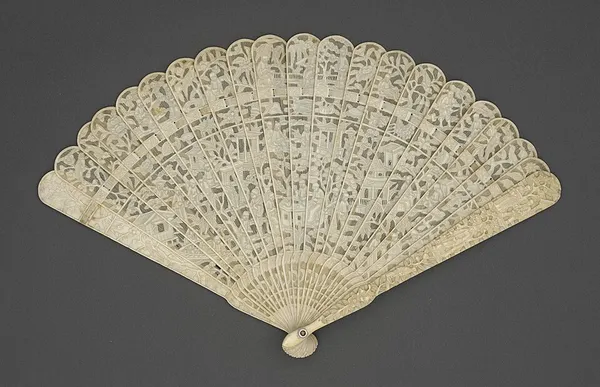
A handheld fan, or simply hand fan, is a broad, flat surface that is waved back and forth to create an airflow. Generally, purpose-made handheld fans are folding fans, which are shaped like a sector of a circle and made of a thin material (such as paper or feathers) mounted on slats which revolve around a pivot so that it can be closed when not in use. Hand fans were widely used before mechanical fans were invented. Fans work by utilizing the concepts of thermodynamics. On human skin, airflow, such as that generated by a hand fan, increases the evaporation rate of sweat, lowering body temperature due to the latent heat of the evaporation of water. It also increases heat convection by displacing the warmer air produced by body heat that surrounds the skin, which has an additional cooling effect, provided that the ambient air temperature is lower than the skin temperature, which is typically about 33 °C (91 °F). Next to the folding fan, the rigid hand screen fan – created from a single flat panel with no folding mechanism – was also a highly decorative and desired object among the higher social classes. They serve a different purpose to the lighter, easier to carry hand fans. Hand screen fans were mostly used to shield a lady's face against the glare of the sun or fire.
Also on this shelf
Gunpowder empires.
Buddhism in Kerala.
See also
Uncatalogued shelfText from Wikipedia; plate via Wikimedia Commons. Text CC BY-SA 4.0; plate freely licensed (see Commons). Source record. Images and catalogue data are reproduced from open-access collections.