Asian Art
Budai
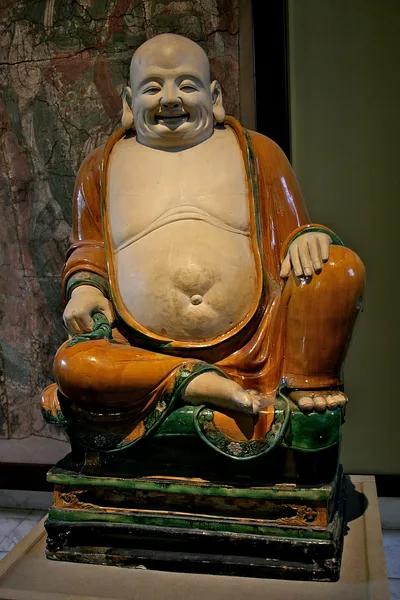
Budai is a nickname given to the historical Chinese monk Qieci (Chinese: 契此; pinyin: qiècǐ) in the Later Liang Dynasty, who is often identified with and venerated as the future Buddha Maitreya in Chan Buddhism and Buddhist scripture. With the spread of Chan Buddhism, he also came to be venerated in Vietnam, Korea, and Japan. The name "Budai" literally means "cloth sack", and refers to the bag he is often depicted carrying as he wanders. His jolly nature and eccentric lifestyle distinguish him from most Buddhist masters or figures. He is almost always shown smiling or laughing, hence his nickname in Chinese, the "Laughing Buddha". Budai is traditionally depicted as having a huge stomach (possibly a symbol of abundance or forgiveness) and many stories surrounding Budai involve his love of food and drink. Because of this, he is also referred to as the "Fat Buddha", especially in the Western world, where he is often mistaken for Gautama Buddha. The main textual record of Budai's life resides in a collection of Chan Buddhist biographies known as The Transmission of the Lamp.
Also on this shelf
British Museum Department of Asia.
Familles jaune, noire, rose, and verte.
See also
Uncatalogued shelfText from Wikipedia; plate via Wikimedia Commons. Text CC BY-SA 4.0; plate freely licensed (see Commons). Source record. Images and catalogue data are reproduced from open-access collections.