Asian Art
Ghaznavid Empire
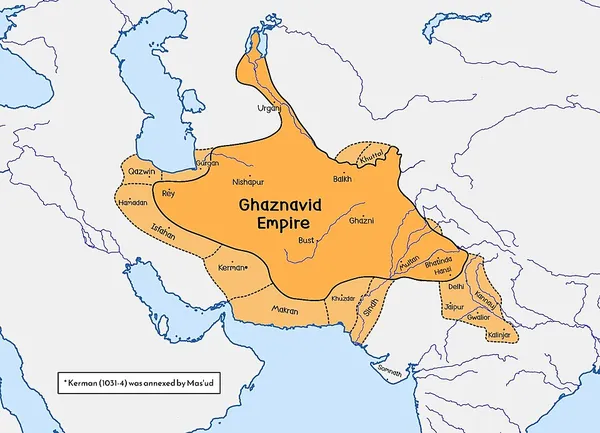
The Ghaznavid Empire (Persian: غزنویان, romanized: Ġaznaviyān) was a culturally Persianate, Sunni Muslim state of Turkic Karluk origin. Flourishing from 977 to 1186, the empire spread from the Oxus to the Indus Valley at its greatest extent. The dynasty was founded by Sabuktigin upon his succession to the rule of Ghazna after the death of his father-in-law, Alp Tigin, who was an ex-general of the Samanid Empire from Balkh. Sabuktigin's son, Mahmud of Ghazni, expanded the Ghaznavid Empire to the Amu Darya, the Indus River and the Indian Ocean in the east and to Rey and Hamadan in the west. Under the reign of Mas'ud I, the Ghaznavid dynasty began losing control over its western territories to the Seljuk Empire after the Battle of Dandanaqan in 1040, resulting in a restriction of its holdings to modern-day Afghanistan, Pakistan and Northern India. In 1151, Sultan Bahram Shah lost Ghazni to the Ghurid sultan Ala al-Din Husayn. The Ghaznavids retook Ghazni but lost the city to the Ghuzz Turks who in turn lost it to Muhammad of Ghor. In response, the Ghaznavids fled to Lahore, their regional capital. In 1186, Lahore was conquered by the Ghurid sultan, Muhammad of Ghor, and its Ghaznavid ruler, Khusrau Malik, was imprisoned and later executed.
Also on this shelf
Culture of Japan.
History of Taiwan.
See also
Uncatalogued shelfText from Wikipedia; plate via Wikimedia Commons. Text CC BY-SA 4.0; plate freely licensed (see Commons). Source record. Images and catalogue data are reproduced from open-access collections.