Asian Art
Hōryū-ji
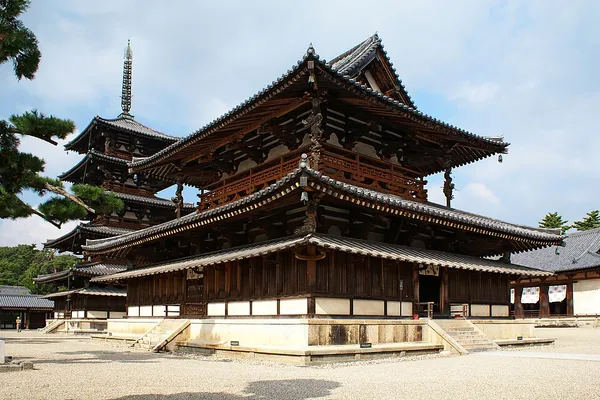
Hōryū-ji (Japanese: 法隆寺; lit. 'Temple of the Flourishing Dharma') is a Buddhist temple that was once one of the powerful Seven Great Temples, located in Ikaruga, Nara Prefecture, Japan. Built shortly after Buddhism was introduced to Japan, it is also one of the oldest Buddhist sites in the country. Its full name is Hōryū Gakumonji (法隆学問寺), or Learning Temple of the Flourishing Law, with the complex serving as both a seminary and monastery. The temple was founded by Prince Shōtoku in 607. According to the Nihon Shoki, in 670 all buildings were burned down by lightning. Reconstruction of the temple complex began soon after. Rebuilt at least 1,300 years ago, the Kondō (main hall) is widely recognized as the world's oldest wooden building. A tree ring survey conducted in 2001 revealed that the shinbashira of the five-story pagoda were cut down in 594, before it burned down in 670. On January 26, 1949, a fire broke out during the dismantling and repair of the Kondō. This heavily damaged the building and also destroyed a mural of the Asuka period, a national treasure, shocking the Japanese. Based on this accident, January 26 is now fire prevention day for cultural properties. In 1993, Hōryū-ji Temple, along with Hokki-ji, was registered as Japan's first UNESCO World Heritage Site under the name of Buddhist Monuments in the Hōryū-ji Area.
Also on this shelf
Christianity in Asia.
East Asian tea ceremony.
See also
Uncatalogued shelfText from Wikipedia; plate via Wikimedia Commons. Text CC BY-SA 4.0; plate freely licensed (see Commons). Source record. Images and catalogue data are reproduced from open-access collections.