Asian Art
Cormorant fishing
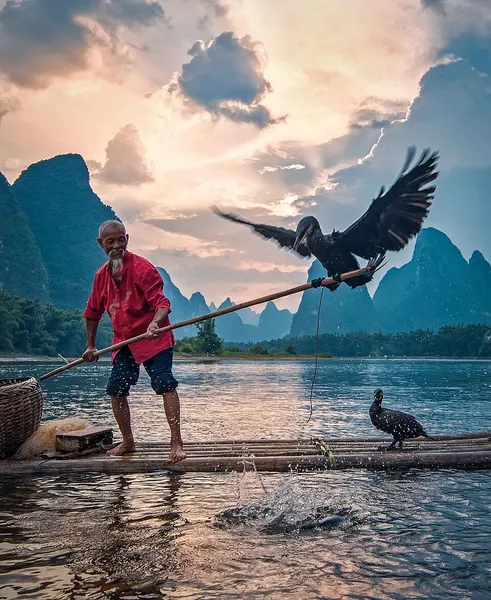
Cormorant fishing is a traditional fishing technique in which fishermen use trained cormorants to catch fish in rivers. Historically, cormorant fishing has taken place in China and Japan, as well as Greece, North Macedonia, and briefly, England and France. Sometimes known as "duck fishing," it was attested as a method used by the ancient Japanese in the Book of Sui, the official history of the Sui dynasty of China, completed in 636 CE. It has significant cultural roots in Asia, specifically in China where it has been practiced for over one thousand years. It is only in China that cormorants have been fully domesticated. Though cormorant fishing was once a successful enterprise, its primary use today is the tourism industry. This artisan fishing method is no longer in commercial use except in southwestern China, where it is under threat from more modern methods. To control the birds, the fishermen tie a loose snare near the base of the bird's throat. The snare does not stop the bird from swallowing small fish, but prevents the bird from swallowing larger fish, which are held temporarily in their gullet. When a cormorant has caught a fish in its throat, the fisherman brings the bird back to the boat and has it regurgitate the fish. The types of cormorants used differ based on the location. Chinese fishermen typically employ the great cormorant (Phalacrocorax carbo), while the Japanese cormorant (Phalacrocorax capillatus) is used in Japan and the neotropic cormorant (Nannopterum brasilianum) in Peru. Darters (birds in the genus Anhinga), which are relatives of cormorants, are also used for this fishing technique on occasion. For cormonant fisherman, this practice is a longstanding tradition, their primary livelihood, and an economic activity. In Asia, cormorants are highly honored and protected. Before the 19th century in Japan, the emperor issued a decree protecting cormorant fishing in Gifu Prefecture by the Imperial Household Department. Cormorant fishing was historically important in several countries around the world. Cormorant fishing practices influenced Asian literature, fine arts, culinary practices, and general recreation.
Also on this shelf
David Rockefeller.
Babylonia.
See also
Uncatalogued shelfText from Wikipedia; plate via Wikimedia Commons. Text CC BY-SA 4.0; plate freely licensed (see Commons). Source record. Images and catalogue data are reproduced from open-access collections.