Asian Art
Chinese numismatic charm
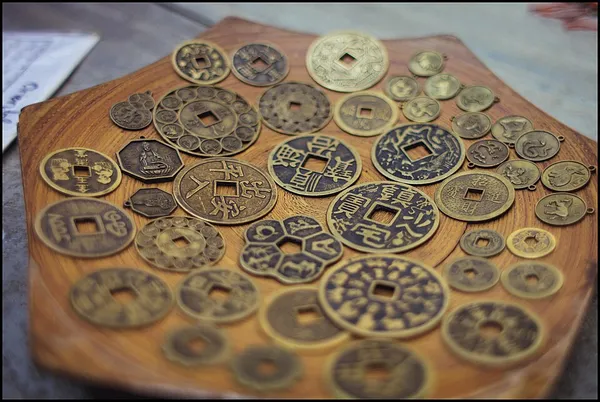
Yansheng coins (traditional Chinese: 厭勝錢; simplified Chinese: 厌胜钱; pinyin: yàn shèng qián), commonly known as Chinese numismatic charms, refer to a collection of special decorative coins that are mainly used for rituals such as fortune telling, Chinese superstitions, and feng shui. They originated during the Western Han dynasty as a variant of the contemporary Ban Liang and Wu Zhu cash coins. Over the centuries, they evolved into their own commodity, with many different shapes and sizes. Their use was revitalized during the Republic of China era. Normally, these coins are privately funded and cast by wealthy families for their own ceremonies, although various governments or religious orders have cast a few types over the centuries. Chinese numismatic charms typically contain hidden symbolism and visual puns. Unlike cash coins, which usually have only two or four Hanzi on one side, Chinese numismatic charms often have more characters and sometimes pictures on the same side. Although Chinese numismatic charms are not legal tender, they used to circulate on the Chinese market alongside regular government-issued coinage. The charms were considered valuable because they were often made of copper alloys, and Chinese coins were valued by their weight in bronze or brass. In some cases, charms were made from precious metals or jade. In certain periods, some charms were used as alternative currencies. For example, "temple coins" were issued by Buddhist temples during the Yuan dynasty when the copper currency was scarce or when copper production was intentionally limited by the Mongol government. Yansheng coins are usually heavily decorated with complicated patterns and engravings. Many of them are worn as fashion accessories or good luck charms. The Qing-dynasty-era cash coins have inscriptions of the five emperors Shunzhi, Kangxi, Yongzheng, Qianlong, and Jiaqing, which are said to bring wealth and good fortune to those who string these five coins together. Chinese numismatic talismans have inspired similar traditions in Japan, Korea, and Vietnam, and often talismans from these other countries can be confused for Chinese charms due to their similar symbolism and inscriptions. Chinese cash coins themselves may be treated as lucky charms outside of China.
Also on this shelf
Chithira Thirunal Balarama Varma.
Kaman-Kalehöyük Archaeological Museum.
See also
Uncatalogued shelfText from Wikipedia; plate via Wikimedia Commons. Text CC BY-SA 4.0; plate freely licensed (see Commons). Source record. Images and catalogue data are reproduced from open-access collections.