Asian Art
History of Vietnam
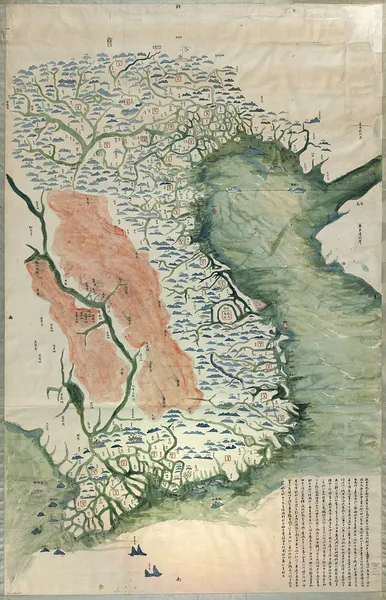
Vietnam, with its coastal strip, rugged mountainous interior, and two major deltas, became home to numerous cultures throughout history. Its strategic geographical position in Southeast Asia also made it a crossroads of trade and a focal point of conflict, contributing to its complex and eventful past. During the Paleolithic period, the first Ancient East Eurasian hunter-gatherers arrived at least 40,000 years ago. Since the Neolithic period, Austroasiatic, as well as Austronesian, Hmong–Mien, Kra–Dai, and Sino-Tibetan peoples that lived across Southeast Asia and Southern China, contributed to the agricultural development and ethnolinguistic landscape of Vietnam. In the first millennium BCE the Đông Sơn culture emerged, based on rice cultivation and focused on the indigenous chiefdoms of Văn Lang and Âu Lạc. Following the 111 BCE Han conquest of Nanyue, much of Vietnam came under Chinese dominance for a thousand years. The period nonetheless saw numerous uprisings, and Vietnamese kingdoms occasionally enjoyed de facto independence. Buddhism and Hinduism arrived by the 2nd century CE, making Vietnam the first place which shared influences of both Chinese and Indian cultures. Independence was regained when the Ngô dynasty was established in 939, and the next millennium saw a succession of local dynasties: Ngô, Đinh, Anterior Lê, Lý, Trần, Hồ, Later Lê, Mạc, Revival Lê, Tây Sơn, and finally Nguyễn. During this period, Vietnam was periodically divided by civil wars, most notably the Trịnh–Nguyễn War of the 17th and 18th centuries, and subjected to foreign interventions by the Song, Yuan, Cham, Ming, Siamese, Qing, and finally the French. In their turn Vietnamese colonizers moved into the Mekong Delta and parts of today's Cambodia between the 15th and 18th centuries. Leveraging its military support for the ascendant Nguyễn dynasty and using the pretexts of protecting religious freedom and trading rights, France conquered Vietnam, dividing its territory into three separate regions, integrating them into French Indochina in 1887. The Second World War brought a 5-year occupation by Imperial Japan. In 1945 Vietnam was proclaimed a republic, but a three-way conflict immediately broke out between communists, anti-communists, and France. In 1949 Vietnam was officially reunified as a partially autonomous member of the French Union.
Also on this shelf
European enslavement of Indigenous Americans.
Egaku.
See also
Uncatalogued shelfText from Wikipedia; plate via Wikimedia Commons. Text CC BY-SA 4.0; plate freely licensed (see Commons). Source record. Images and catalogue data are reproduced from open-access collections.